



Why Modern Life Leaves Our Brains Feeling So Tired
Table of Contents
Introduction
1. Your Brain Is Processing More Than Ever Before
2. Constant Switching Drains Mental Energy
3. Decision Making Adds Up
4. Rest Is Not the Same as Recovery
5. Small Breaks Can Improve Focus
6. Healthy Habits Support Brain Health
7. A Healthy Brain Starts With Everyday Choices
Conclusion
Introduction
Feeling mentally tired has become so common that many people accept it as a normal part of modern life. Even after a full night’s sleep, it is possible to wake up feeling mentally drained before the day has truly begun. By evening, many of us feel as though our attention has been stretched in countless different directions.
Unlike physical tiredness, mental fatigue is not always easy to recognise. It may appear as difficulty concentrating, forgetting simple tasks, feeling overwhelmed by small decisions, or struggling to stay focused during conversations. These experiences are increasingly common in a world where our attention is constantly competing with emails, notifications, meetings, and endless streams of information.
While modern technology has made life more convenient in many ways, it has also introduced new demands on our brains. We are expected to process more information, make more decisions, and switch between tasks more frequently than ever before. As a result, many people feel mentally exhausted even when they have not performed physically demanding work.
Understanding why this happens is the first step towards protecting our brain health. Although we cannot eliminate every source of stress, we can build habits that reduce unnecessary mental strain and support clearer thinking over time.
1. Your Brain Is Processing More Than Ever Before
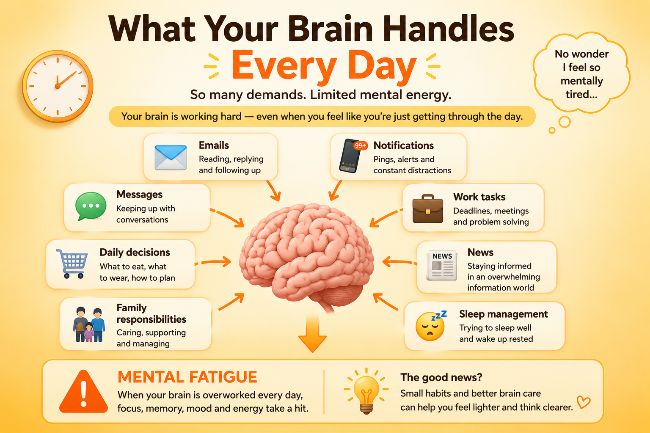
Every day, your brain is exposed to an enormous amount of information. Emails, instant messages, news updates, social media feeds, advertisements, and workplace communication all compete for your attention.
Unlike previous generations, today’s technology allows information to reach us almost instantly, wherever we are. Even moments that were once quiet, such as waiting in a queue or travelling on public transport, are now often filled with screen time.
Each piece of information may seem small on its own, but together they require continuous processing. The brain must constantly decide what deserves attention and what can be ignored, creating an ongoing demand for mental energy.
This constant stimulation does not necessarily make us more productive. In many cases, it simply leaves the brain with fewer opportunities to recover throughout the day.
2. Constant Switching Drains Mental Energy
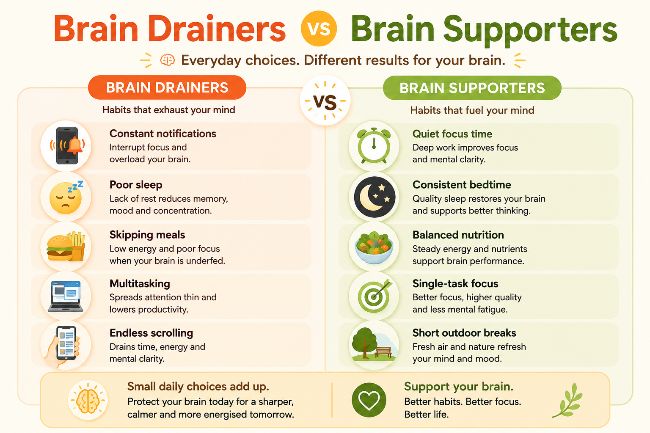
Many people believe they are good at multitasking, but research suggests that the brain performs better when focusing on one task at a time. Frequently switching between emails, phone notifications, meetings, and conversations requires the brain to repeatedly adjust its attention.
Each transition may only take a few seconds, but these small interruptions accumulate throughout the day. By the afternoon, many people feel mentally tired despite having spent most of the day sitting at a desk.
This phenomenon is sometimes referred to as attention switching. Rather than completing tasks more efficiently, constant switching often increases cognitive effort while reducing overall focus.
Creating longer periods of uninterrupted work allows the brain to concentrate more effectively and reduces unnecessary mental strain.
3. Decision Making Adds Up
From the moment we wake up, our brains begin making decisions. What should I wear? What should I eat? Which email should I answer first? Should I exercise today or tomorrow?
Most of these decisions seem insignificant individually, yet together they consume valuable mental resources. By the end of the day, decision fatigue can make even simple choices feel surprisingly difficult.
One reason routines are so helpful is that they reduce the number of decisions we need to make. When healthy meals, bedtime routines, or exercise schedules become habits, the brain no longer needs to debate them every day.
Protecting mental energy is not about avoiding responsibility. It is about reducing unnecessary decisions wherever possible.
4. Rest Is Not the Same as Recovery
Many people assume that sitting on the sofa while scrolling through social media is a form of rest. While it may feel relaxing, the brain is often still processing new information, images, videos, and conversations.
True mental recovery usually involves reducing stimulation rather than replacing one type of stimulation with another. Spending time outdoors, enjoying quiet moments, reading, or practising mindfulness can all provide opportunities for the brain to slow down.
Quality sleep also plays a critical role in supporting mental recovery. Establishing a consistent bedtime routine allows the brain to perform many of the processes that support learning, memory, and overall wellbeing.
Recovery is not simply about doing less. It is about giving the brain a genuine opportunity to recharge.
5. Small Breaks Can Improve Focus
Many people try to work continuously for hours without stopping, believing this demonstrates productivity. In reality, short breaks can often improve concentration by giving the brain time to reset.
Stepping away from the computer, stretching, taking a short walk, or simply looking away from a screen for a few minutes can help reduce mental fatigue during long working days.
These breaks do not need to be lengthy. Even brief pauses throughout the day can help restore attention and improve overall focus.
Rather than viewing breaks as interruptions, consider them part of maintaining mental performance.
6. Healthy Habits Support Brain Health
Mental wellbeing is influenced by more than work habits alone. Everyday lifestyle choices also play an important role in supporting overall brain health.
Regular sleep, balanced nutrition, physical activity, hydration, and stress management all contribute to creating an environment where the brain can function at its best.
No single habit provides an instant solution. Instead, it is the combination of consistent healthy behaviours that helps support mental resilience over time.
Looking after the brain should not be reserved for periods of high stress. It is something worth prioritising every day.
7. A Healthy Brain Starts With Everyday Choices
Modern life will probably never become less busy. Technology, work, and responsibilities will continue demanding our attention. Rather than trying to eliminate these challenges completely, we can focus on strengthening the habits that help us manage them more effectively.
Protecting brain health does not require dramatic lifestyle changes. It often begins with small decisions repeated consistently, such as creating routines, limiting unnecessary distractions, prioritising sleep, and making time for genuine recovery.
The goal is not to avoid mental effort altogether. It is to ensure that our brains receive the support they need to perform well, both today and in the years ahead.
Looking after your brain is ultimately an investment in your ability to think clearly, stay focused, and enjoy everyday life.
Conclusion
Mental fatigue has become a common part of modern life, but it does not have to be accepted as inevitable. By understanding the everyday demands placed on our brains, we can make more intentional choices that support focus, recovery, and overall wellbeing.
Simple habits such as maintaining consistent routines, taking regular breaks, prioritising sleep, and reducing unnecessary distractions all contribute to better brain health over time. These actions may seem small individually, but together they help create a healthier environment for the brain to thrive.
Looking after your brain is not about doing more. It is about creating space for it to perform at its best, even in an increasingly busy world.
Supporting Everyday Brain Wellness
For those looking to complement healthy lifestyle habits with nutritional support, IQ No.1 by Abeille d’Or contains bee pollen, royal jelly calcium, vitamin B complex, beta carotene, and rooibos tea extract to support brain function, mental focus, and mood balance as part of a balanced daily routine.