


Why Do We Forget Names but Remember Songs? The Curious Science of Everyday Memory
Table of Contents
Introduction
1. How Does Human Memory Actually Work?
2. Why Are People’s Names So Difficult to Remember?
3. Why Can a Familiar Song Bring Back Memories Instantly?
4. The Powerful Relationship Between Emotion and Memory
5. Why Sometimes We Remember Something Only After We Stop Trying
6. Can We Become Better at Remembering Everyday Information?
7. When Is Everyday Forgetfulness Normal, and When Should We Pay Attention?
Conclusion
Introduction
Have you ever bumped into an old colleague at a shopping mall, recognised their face immediately, remembered where you worked together, and yet struggled to recall their name? The conversation continues politely while your mind searches for that missing piece of information. Then, several hours later, the name suddenly appears when you are no longer thinking about it. It is a strangely familiar experience, and one that raises an interesting question about how our memory actually works.
Now consider a different situation. You are driving home through Kuala Lumpur when a familiar song plays on the radio. Within seconds, you remember the lyrics, the melody and perhaps even a particular moment from your school days. You might recall singing with friends, attending a family celebration or listening to the same song during a memorable journey. Somehow, information you have not consciously revisited for years can return with surprising clarity.
These contrasting experiences reveal something fascinating about human memory. Our brains do not store and retrieve every piece of information in the same way. Remembering a person’s name, recognising a familiar face, recalling a childhood event and singing along to an old favourite all involve different combinations of cognitive processes. Some memories depend heavily on deliberate recall, while others become accessible through familiar sounds, emotions or associations.
Understanding how human memory works can help us appreciate why certain details disappear while others remain remarkably accessible. More importantly, it challenges the assumption that forgetting something automatically means our memory is becoming weaker. By exploring the science of attention, association, emotional experiences and memory retrieval, we can discover why everyday forgetfulness happens and how to become more thoughtful about the information we want to remember.
1. How Does Human Memory Actually Work?
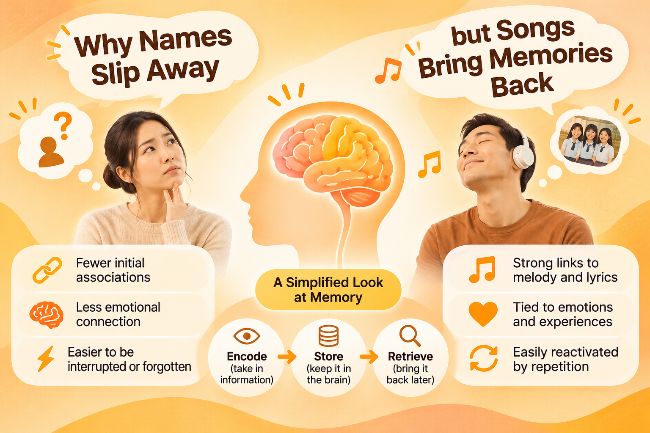
Human memory is not a single storage system that records everything we experience. Instead, it involves several interacting processes that allow us to take in information, retain it and access it when needed. Psychologists commonly describe three fundamental stages: encoding, storage and retrieval. Although these stages are closely connected, understanding their differences helps explain many familiar memory experiences.
Encoding occurs when information is initially processed and represented in the brain. Imagine meeting someone at a friend’s Deepavali open house. You hear their name, notice their appearance and exchange a few words about their occupation. Your brain has the opportunity to encode these details, but how effectively this happens depends partly on your attention, the context and whether the information connects with anything meaningful.
Storage refers to the processes that maintain information over time. Some information remains available only briefly, while other experiences contribute to longer-lasting memories. The hippocampus plays an important role in forming and organising many new memories, particularly memories of events. Other brain networks participate in language, knowledge, emotional associations and learned skills. Memory is therefore distributed across interconnected systems rather than kept in one location.
Retrieval is the process of accessing stored information. This is where everyday difficulties often appear. You may recognise a person’s face and remember their profession without retrieving their name. That does not necessarily mean every detail about the person has disappeared. Sometimes, the information is difficult to access without an appropriate reminder. The distinction between information that was never properly encoded and information that is temporarily difficult to retrieve is essential to understanding forgetfulness.
2. Why Are People’s Names So Difficult to Remember?
Names present a particularly interesting challenge because they often carry little descriptive information about the people they identify. If someone introduces themselves as Daniel, the name does not automatically tell you anything about their personality, appearance or occupation. Unlike descriptive information, which can connect naturally with existing knowledge, a personal name often requires us to remember a relatively arbitrary association between a sound and an individual.
Research in cognitive psychology has consistently shown that proper names are often harder to retrieve than other information about familiar people. We may remember that someone works in accounting, enjoys badminton and has two children, yet struggle to remember what they are called. The brain can access several meaningful associations while still having difficulty retrieving the specific verbal label required.
The circumstances of an introduction can make this challenge greater. At a busy Malaysian wedding dinner, for example, conversations may happen quickly while music plays and relatives move between tables. You might hear several unfamiliar names within minutes. If your attention is divided between introductions, greetings and the surrounding activities, some names may receive insufficient processing to form durable memories.
Fortunately, remembering names can become easier when we create meaningful connections. Repeating a name naturally during conversation, associating it with a distinctive detail and mentally recalling it after the introduction can strengthen learning. Instead of simply hearing a name, we give it additional context and opportunities for retrieval. These techniques do not guarantee perfect recall, but they make the information less dependent on a single, brief introduction.
3. Why Can a Familiar Song Bring Back Memories Instantly?
Music has a remarkable ability to connect with personal experiences. A song played during a school graduation, family gathering or long journey may become associated with the people, emotions and surroundings of that occasion. Years later, hearing the same melody can activate those associations and make the experience feel unexpectedly close. Psychologists call this phenomenon music-evoked autobiographical memory.
Unlike a name, which may be encountered only occasionally, a favourite song often contains multiple memorable elements. Its melody, rhythm, lyrics and emotional character provide several potential retrieval cues. Repeated listening can strengthen familiarity, while personal experiences give the music additional meaning. These features help explain why a song can prompt memories that might otherwise be difficult to recall deliberately.
Scientific studies support this connection. Research published in Memory & Cognition found that musical excerpts were more likely to evoke autobiographical memories than spoken versions of the same lyrics. More recent research published in 2026 also found that familiar songs could effectively cue memories in both younger and older adults. These findings suggest that music’s combination of familiarity and personal context can make it an especially useful reminder of past experiences.
This is particularly relatable in Malaysia, where music often accompanies cultural celebrations, family occasions and different stages of life. A familiar festive song may remind someone of childhood visits to relatives, while an old radio favourite might bring back memories of university days. The song itself does not contain those experiences. Rather, it provides a familiar pathway through which associated personal memories can become accessible again.
4. The Powerful Relationship Between Emotion and Memory
Emotion can influence how strongly certain experiences are remembered. Think about a childhood birthday celebration, an important examination result or the first time you travelled somewhere independently. These experiences may remain memorable because they carried personal significance. Emotional responses can influence attention and memory processes, making some details more likely to be retained or recalled.
The amygdala, a brain region involved in processing emotional significance, interacts with systems responsible for memory formation. Research suggests that emotional arousal can strengthen memory for certain aspects of an experience. However, this does not mean emotional memories are always more accurate. People can remember the central meaning of an emotional event vividly while misremembering surrounding details.
Emotion also helps explain why particular songs become attached to meaningful periods of our lives. A melody associated with friendship, family or an important milestone may prompt feelings of nostalgia years later. These feelings can make the remembered experience seem vivid and personally significant. Music-related memories are therefore not simply about recognising musical patterns, but also about retrieving experiences connected to our identities.
There is another important distinction between feeling that a memory is vivid and knowing that every detail is correct. Human memory is reconstructive, meaning that remembering involves rebuilding an experience using available information rather than replaying an exact recording. Our expectations, later knowledge and emotions can influence this process. Appreciating the emotional richness of memories while recognising their limitations gives us a more accurate understanding of how remembering works.
5. Why Sometimes We Remember Something Only After We Stop Trying
One of the most frustrating memory experiences is knowing that information feels familiar but being unable to produce it. Psychologists describe a related phenomenon as the tip-of-the-tongue state. You may remember the first letter of someone’s name, the approximate number of syllables or where you met them, yet the complete answer remains inaccessible. This experience highlights the difference between partial knowledge and successful retrieval.
Trying harder does not always produce an immediate solution. Repeatedly searching through the same associations may lead us back to incorrect answers or familiar but unhelpful clues. Later, a different conversation, location or thought may provide a more effective retrieval cue. This can make the answer appear to emerge spontaneously, even though memory retrieval involves underlying cognitive processes.
Context is particularly important. Imagine recognising a former teacher at a pasar malam but struggling to recall their name. Later, while discussing your school days with a friend, the name suddenly comes to mind. The school-related conversation may provide associations that were unavailable during the unexpected encounter. Retrieval often becomes easier when the current situation resembles aspects of the original learning experience.
This suggests a practical approach to everyday forgetfulness. Rather than repeatedly forcing an answer, consider exploring related information such as where you met the person, what you discussed or who introduced you. If the information remains inaccessible, moving on temporarily may be reasonable. Although taking a break does not guarantee recall, changing the available cues can sometimes make retrieval easier. Forgetfulness is not always a sign that information has been permanently lost.
6. Can We Become Better at Remembering Everyday Information?
While memory abilities differ between individuals, research has identified learning strategies that can improve retention of information. One particularly useful principle is retrieval practice, which involves actively attempting to recall something instead of simply reviewing it repeatedly. When we retrieve newly learned information, we create additional opportunities to strengthen our ability to access it later.
For example, after meeting a new colleague, you might mentally recall their name a few minutes later rather than repeatedly reading it from a contact list. If you are learning something new for work, explaining the information in your own words can provide another form of retrieval practice. Research in learning psychology indicates that active recall can support long-term retention across many educational settings, although results depend on the material and learning conditions.
Spacing is another important principle. Instead of concentrating all your learning into one session, reviewing information across several occasions can improve retention. A person learning new terminology, for example, may benefit from revisiting it over several days rather than memorising everything immediately before a meeting. Combining spaced learning with active recall offers a practical, evidence-informed approach to remembering information that matters.
Meaningful associations can make these techniques more relevant to everyday life. Connecting a new person’s name with a conversation, linking an important fact to a familiar example or explaining something to a family member may provide useful retrieval cues. The objective is not to memorise every minor detail. It is to process important information more thoughtfully and give ourselves opportunities to retrieve it. Memory strategies work best when matched to the information and circumstances involved.

7. When Is Everyday Forgetfulness Normal, and When Should We Pay Attention?
Occasionally forgetting names, misplacing belongings or taking longer to recall information can happen at different stages of life. Memory performance is influenced by factors including attention, sleep, emotional wellbeing and the circumstances in which information is learned. An isolated memory lapse therefore does not automatically indicate a serious cognitive problem.
Ageing can also affect some aspects of memory, particularly the speed of retrieving certain information. According to the US National Institute on Aging, mild forgetfulness can occur with normal ageing, but more serious memory difficulties may interfere with everyday independence. There is an important difference between occasionally forgetting someone’s name and repeatedly becoming lost in familiar surroundings or struggling to complete previously manageable activities.
Other health-related factors can contribute to memory difficulties. Sleep disturbances, certain medications, nutritional deficiencies, psychological distress and medical conditions may influence cognitive functioning. This is why persistent changes deserve appropriate assessment rather than assumptions about their cause. A healthcare professional can consider the broader circumstances and determine whether further investigation is necessary.
It is also important to distinguish normal memory support from exaggerated promises of cognitive improvement. No single food, supplement or technique can guarantee perfect recall or prevent every form of cognitive decline. General wellbeing, adequate nutrition, appropriate physical activity, sufficient sleep and meaningful social engagement all contribute to overall health. When memory difficulties become progressive, unusual or disruptive to daily life, professional medical advice is more appropriate than relying on self-diagnosis or unproven solutions.

Conclusion: Memory Is More Than Simply Remembering or Forgetting
The contrast between forgetting someone’s name and remembering an old song reveals how remarkably complex human memory really is. Rather than operating as a perfect recording system, our brains organise experiences through attention, associations, emotions and different forms of learning. Some information becomes difficult to retrieve because it was never strongly encoded, while other memories remain accessible through familiar sounds, meaningful connections or contextual reminders.
Understanding these processes can change the way we respond to everyday forgetfulness. Instead of interpreting every missed name or forgotten detail as evidence of declining memory, we can recognise the many factors that influence recall. We can also become more intentional about remembering important information by paying attention, making meaningful associations and practising retrieval over time.
Perhaps the most fascinating aspect of memory is that it connects knowledge with personal experience. A familiar melody can bring back the atmosphere of a childhood celebration, while an old photograph may remind us of people and places we have not thought about for years. These memories help shape our sense of identity, relationships and belonging. Caring for our cognitive wellbeing begins with understanding how memory works, appreciating its complexity and recognising when changes deserve closer attention.
Supporting Everyday Cognitive Nutrition
Alongside balanced meals, adequate sleep and an active lifestyle, appropriate nutrition contributes to normal brain and nervous system functioning. Abeille d’Or IQ No.1 contains bee pollen, royal jelly, calcium, vitamin B complex, beta carotene and rooibos tea extract. It may be considered as a complementary nutritional option within a balanced wellness routine, rather than a substitute for healthy living or professional care.