


Why Do Children Dislike Vegetables? The Science Behind Picky Eating
Table of Contents
Introduction
1. Why Children Experience Vegetables Differently From Adults
2. Food Neophobia: Why Children Fear Unfamiliar Foods
3. Texture, Appearance and Smell Matter More Than Parents Realise
4. Why Repeated Exposure Can Help Children Accept Vegetables
5. How Family Mealtimes Shape Children’s Food Preferences
6. Practical Ways Malaysian Parents Can Make Vegetables More Appealing
7. Building Healthy Habits Without Turning Food Into a Battle
Conclusion
Introduction
Picture a typical Malaysian family dinner. There is rice, chicken, a bowl of soup and a plate of stir-fried sawi or kailan in the middle of the table. Everything seems perfectly ordinary until a parent places a few vegetables on their child’s plate. Suddenly, the child pushes them aside, makes a face or declares that they taste terrible without even trying them. What began as a peaceful family meal becomes a negotiation involving promises, encouragement and perhaps a little frustration.
For many parents, this situation is familiar. Children who happily eat noodles, chicken, eggs and fruit may become remarkably selective when vegetables appear. Some refuse anything green, while others accept carrots in soup but reject the same carrots when stir-fried. Parents naturally worry whether their children are receiving enough nutrients, especially during important years of growth and development. Yet vegetable rejection is not always a sign of stubbornness or poor parenting. There are genuine developmental, sensory and psychological reasons why children respond differently to certain foods.
The question of why children dislike vegetables has attracted considerable interest from nutrition researchers and child development specialists. Research suggests that children’s food preferences are influenced by biological taste sensitivity, repeated exposure, familiarity, temperament and their experiences around mealtimes. Vegetables can present particular challenges because some contain naturally bitter compounds, have unfamiliar textures or look different depending on how they are prepared. Understanding these factors can help parents respond more effectively without turning every meal into a battle.
Fortunately, helping children develop healthier eating habits does not require elaborate recipes or constant persuasion. Small, consistent opportunities to explore vegetables can gradually make unfamiliar foods feel more acceptable. For Malaysian families, this can mean working with familiar dishes such as fried rice, noodle soup, omelettes and home-cooked curries rather than completely changing the family menu. The goal is not to make every child love every vegetable, but to create a supportive environment where curiosity, confidence and dietary variety can develop over time.
1. Why Children Experience Vegetables Differently From Adults
Children do not necessarily experience flavours in the same way adults do. Their responses to food are shaped by developing sensory systems, individual taste sensitivity and previous eating experiences. A vegetable that tastes pleasantly earthy to an adult may seem unusually bitter or intense to a young child. This difference helps explain why parents and children can have completely different reactions to the same dish.
One important factor is bitterness. Certain vegetables contain naturally occurring compounds that activate bitter taste receptors. Humans vary in how strongly they perceive these compounds, partly because of genetic differences. Some children may therefore find particular vegetables more unpleasant than others do. Although bitterness sensitivity does not determine every food preference, it can contribute to the initial rejection of vegetables such as broccoli, certain leafy greens and other strongly flavoured foods.
Children also tend to have a natural preference for sweet flavours. Sweetness is familiar from early life, whereas bitter flavours may require more learning and exposure. This does not mean children are biologically destined to dislike vegetables. Instead, it suggests that some vegetables may need to become familiar through repeated, positive experiences before children willingly eat them.
Parents can respond by experimenting with preparation methods rather than assuming a rejected vegetable will never be accepted. Lightly steaming vegetables, adding them to familiar dishes or serving them with flavours the family already enjoys may make them more approachable. The aim is not to disguise every vegetable, but to help children discover preparations they genuinely enjoy.
2. Food Neophobia: Why Children Fear Unfamiliar Foods
Food neophobia refers to a reluctance to try unfamiliar foods. It is a common developmental behaviour, particularly during early childhood. A toddler who previously accepted many different foods may suddenly become suspicious of anything new. Parents sometimes interpret this change as deliberate defiance, but it can reflect a normal stage of development.
From a developmental perspective, caution around unfamiliar foods may have served a protective function. Young children exploring their surroundings benefit from some hesitation before eating unknown substances. In modern family environments, however, this cautious response can extend to perfectly safe and nutritious foods, including vegetables that look, smell or feel unfamiliar.
Food neophobia can become particularly noticeable when vegetables are presented in different forms. A child who accepts finely chopped carrots in fried rice might reject carrot sticks because they look different. Similarly, a child accustomed to soft vegetables in soup may hesitate when offered crunchy raw vegetables. Familiarity with one preparation does not automatically transfer to every other version.
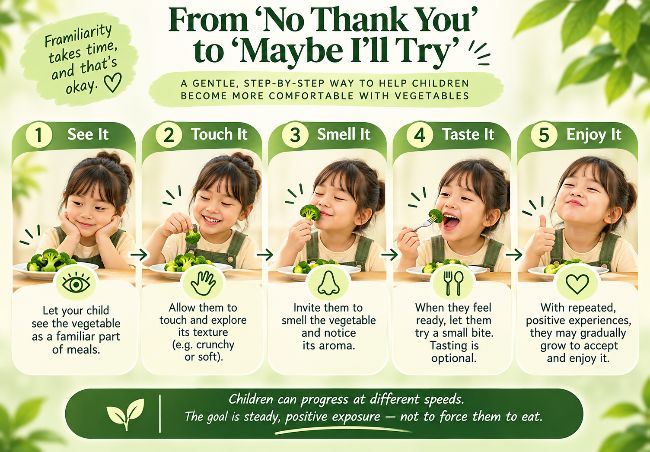
Parents can make unfamiliar foods less intimidating by introducing them alongside accepted foods and allowing children to explore without pressure. Seeing, touching, smelling or helping prepare a vegetable can all contribute to familiarity. A child does not necessarily need to swallow a new food during the first encounter for the experience to be useful.
3. Texture, Appearance and Smell Matter More Than Parents Realise
Taste is only one part of the eating experience. Texture, temperature, appearance and smell also influence whether children accept a food. Some children dislike slippery cooked spinach, while others reject crunchy cabbage or vegetables with visible fibres. These responses may reflect genuine sensory preferences rather than an attempt to be difficult.
Vegetables are especially variable because cooking changes their sensory characteristics. Sawi may become soft and slightly bitter when boiled, while cabbage can remain crunchy when lightly stir-fried. Okra has a distinctive slippery texture, and eggplant becomes soft when cooked. For a child who prefers predictable foods, these differences can make vegetables challenging.
Presentation also matters. Children may feel more comfortable when unfamiliar foods are served separately rather than mixed into a large dish. A small portion of carrots beside rice, for example, allows a child to observe the vegetable without feeling that the entire meal has changed. Other children may prefer vegetables incorporated into familiar dishes.
Parents can experiment with different textures and presentations while respecting individual preferences. Offering steamed, roasted, lightly stir-fried or finely chopped vegetables provides opportunities to discover what works. If a child consistently struggles with numerous textures, experiences gagging or has a very restricted diet, professional assessment may be appropriate.
4. Why Repeated Exposure Can Help Children Accept Vegetables
One of the most useful findings in childhood nutrition research is that familiarity can influence food acceptance. Children may need multiple opportunities to encounter an unfamiliar vegetable before they become comfortable tasting it. A single rejection therefore provides limited information about whether a child might eventually enjoy that food.
Repeated exposure works best when experiences remain neutral or positive. Parents might offer a small piece of cucumber alongside lunch several times without insisting that it be eaten. Over time, the vegetable becomes a familiar part of the child’s environment. Some children may eventually become curious enough to taste it voluntarily.
There is no universal number of exposures that guarantees acceptance. Progress varies according to age, temperament, sensory sensitivity and the particular vegetable. Some children respond relatively quickly, while others require many opportunities. Parents should avoid treating exposure as a countdown after which a child must finally eat the food.
A practical Malaysian example involves introducing leafy greens through familiar meals. Parents might first place a little sawi beside noodle soup, later offer a small amount mixed into the soup, and eventually invite the child to help prepare it. The important element is consistency without coercion, allowing acceptance to develop gradually.
5. How Family Mealtimes Shape Children’s Food Preferences
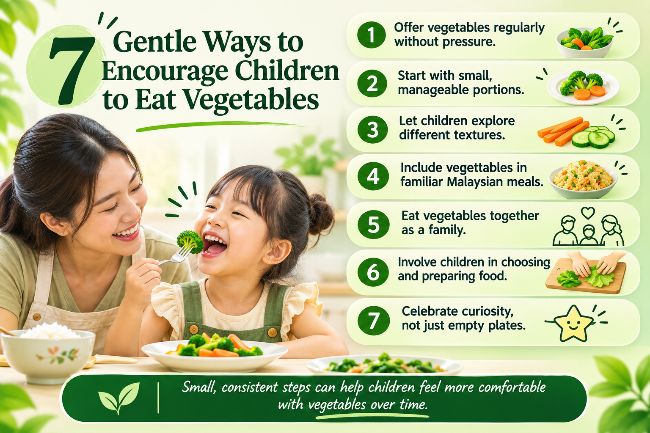
Children learn about food partly by observing the people around them. When parents, siblings and other family members regularly eat vegetables, children receive repeated examples of vegetables being a normal part of everyday meals. This modelling can be more influential than lengthy explanations about vitamins or healthy eating.
Family meals offer opportunities for this learning. A child watching a parent enjoy kangkung with rice may gradually become more curious about the dish. Parents can describe vegetables positively without exaggeration, perhaps mentioning that carrots are crunchy or that cabbage tastes slightly sweet when cooked. Such observations invite curiosity without demanding agreement.
Pressure, however, can complicate mealtimes. Repeated commands to finish vegetables, threats of punishment or promises of dessert in exchange for eating greens may increase tension. Although these approaches sometimes produce immediate compliance, they do not necessarily help children develop lasting preferences for vegetables.
A more supportive approach involves parents deciding what foods are offered and establishing predictable mealtime routines, while allowing children appropriate autonomy over how much they eat. This does not mean abandoning nutritional guidance. It means combining structure, variety and patience so that eating remains a positive family experience.
6. Practical Ways Malaysian Parents Can Make Vegetables More Appealing
Healthy eating advice often assumes families have unlimited time to prepare elaborate meals. In reality, Malaysian parents may be balancing work, school schedules, commuting and household responsibilities. Encouraging children to eat vegetables therefore needs to fit into ordinary family routines rather than becoming another demanding project.
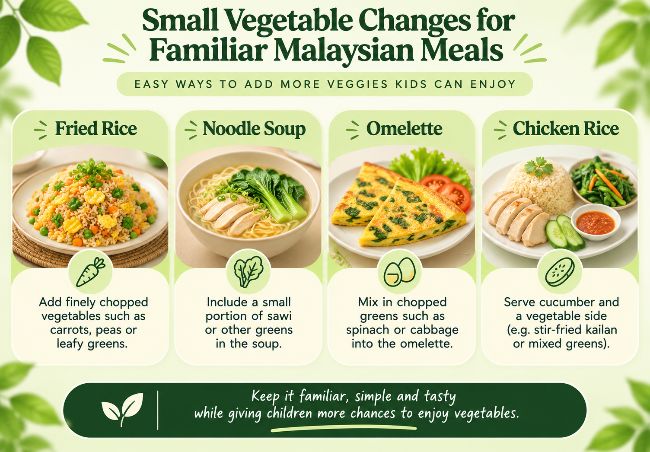
One practical strategy is to use familiar dishes as opportunities for variety. Fried rice can include carrots, peas or finely chopped leafy vegetables. Omelettes can contain spinach or cabbage. Noodle soup can be served with small portions of sawi, while chicken rice can include cucumber and an additional vegetable side. These adjustments preserve familiar flavours while increasing opportunities for exposure.
Involving children in preparation can also help. Younger children might wash vegetables, arrange cucumber slices or choose between two vegetable options. Older children can help stir ingredients, assemble simple dishes or select vegetables during grocery shopping. Participation can increase familiarity and give children a sense of ownership over their meals.
Parents should also consider convenience. Frozen vegetables, pre-washed greens and simple preparations can reduce the effort required to offer variety. A nutritious meal does not need to look elaborate. Consistency, accessibility and a relaxed atmosphere are often more realistic foundations for long-term improvement than complicated recipes.
7. Building Healthy Habits Without Turning Food Into a Battle
Parents naturally want children to receive adequate nutrition, but an excessive focus on individual meals can create unnecessary anxiety. A child who refuses vegetables at dinner has not necessarily experienced a nutritional failure. Dietary quality is better considered across a broader pattern of meals and food groups rather than judged from one plate.
It is also important to recognise that children differ in appetite and development. Appetite can fluctuate with growth, activity, illness and daily routines. Some children may eat enthusiastically at one meal and very little at another. Parents can provide balanced opportunities for eating while remaining attentive to genuine hunger and fullness cues.
When vegetable rejection becomes persistent or severe, parents should look beyond ordinary pickiness. Significant weight concerns, nutritional deficiencies, distress during meals, swallowing difficulties or an extremely limited range of accepted foods warrant discussion with a qualified healthcare professional. These situations may require more individualised guidance than general feeding strategies can provide.
Ultimately, the objective is to develop a healthier relationship with food. A child who feels comfortable exploring unfamiliar vegetables, watching family members enjoy varied meals and making gradual choices is learning skills that can extend beyond childhood. Progress may be slow, but every positive experience contributes to a more supportive foundation for lifelong eating habits.
Conclusion
Understanding why children dislike vegetables begins with recognising that food preferences are shaped by more than personal choice. Taste sensitivity, unfamiliar textures, developmental caution and mealtime experiences all influence how children respond to vegetables. What appears to be stubbornness may simply reflect a child’s developing relationship with food.
For Malaysian parents, the most sustainable approach is often to work with existing family meals rather than attempting dramatic dietary changes. Familiar dishes can become opportunities to introduce vegetables gradually, while shared meals provide valuable examples of varied eating. Patience, repeated exposure and a relaxed environment can make these experiences more positive.
Not every child will learn to enjoy every vegetable, and that is perfectly reasonable. The broader goal is to encourage dietary variety, support adequate nutrition and help children feel confident exploring food. Small improvements repeated over time can be more valuable than short-term victories achieved through pressure.
A Little Extra Convenience for Busy Families
For families looking for convenient ways to incorporate more plant-based ingredients into everyday routines, Abeille d’Or Green Kale offers an additional option. It can complement a varied diet, although it should not replace whole vegetables or the sensory learning children gain from eating them. Parents should check product suitability and age-specific guidance before offering supplements to children.