



Are We Outsourcing Our Health to Convenience?
Table of Contents
Introduction
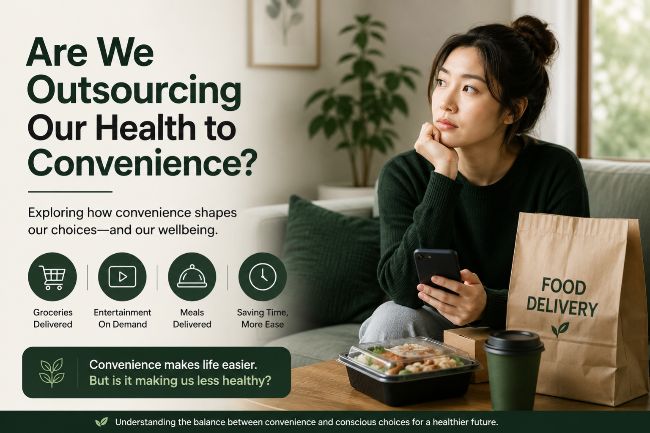
Modern life is built around convenience. We can order groceries without entering a store, stream entertainment without leaving the couch, and have meals delivered to our doorstep within minutes. Many of these innovations have made life easier, saving time and reducing the effort required to complete everyday tasks.
There is no doubt that convenience has improved many aspects of modern living. Busy professionals, parents, students, and caregivers often rely on time saving solutions to balance competing responsibilities. In many cases, these services provide valuable support that allows people to focus on work, family, and personal priorities.
Yet as convenience becomes increasingly integrated into daily life, an important question is beginning to emerge. Have we become so focused on making life easier that we have unintentionally become less connected to our health? More specifically, have we started outsourcing decisions that were once closely tied to our wellbeing?
This is not about blaming technology or modern lifestyles. Rather, it is about understanding how convenience influences our choices and examining whether some aspects of health still require our active participation.
The Age of Convenience
Few periods in history have offered as much convenience as the modern era. Technology has transformed the way people shop, communicate, work, travel, and eat. Tasks that once required planning and effort can now be completed in seconds with a smartphone.
The food industry has embraced this shift wholeheartedly. Consumers can choose from countless ready meals, meal delivery services, food delivery platforms, and packaged products designed to simplify eating. For many people, these options are not luxuries but necessities that help them manage demanding schedules.
Convenience itself is not inherently negative. In fact, it often serves an important purpose. The challenge arises when convenience becomes the primary factor influencing food choices. When speed consistently takes priority over quality, nutrition can gradually become a secondary consideration.
The result is a food environment where making convenient choices is often easier than making intentional ones.
When Convenience Becomes the Default
One of the most interesting aspects of human behaviour is that people tend to follow the path of least resistance. This is not a sign of laziness. It is simply how the brain conserves energy. Given two options, most individuals will naturally gravitate toward the one that requires less effort.
This principle explains why convenience has become such a powerful force in modern life. Every small reduction in effort increases the likelihood that a behaviour will be repeated. Ordering food is often easier than cooking. Buying a packaged snack is often easier than preparing fresh ingredients. Choosing what is available now is often easier than planning ahead.
Over time, these small decisions begin to shape larger patterns. A single convenience based choice is rarely significant on its own. However, repeated consistently, these choices can influence dietary habits, nutritional intake, and overall lifestyle behaviours.
Understanding this dynamic is important because it highlights that health outcomes are often influenced by systems and environments, not just individual willpower.
The Nutrition Trade-Off We Rarely Discuss
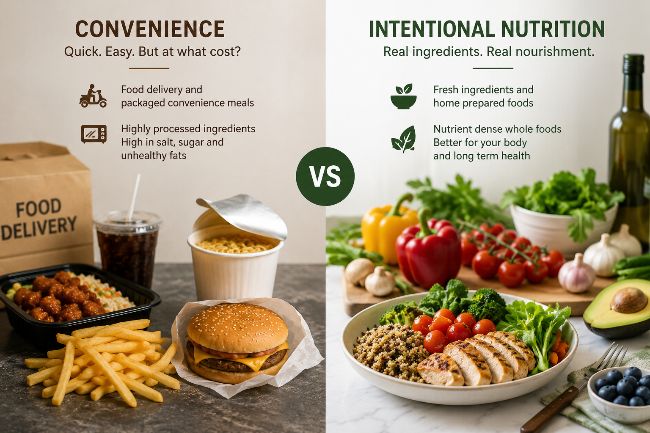
Convenience has helped solve many problems, but it has also introduced new challenges. One of the most overlooked is the gradual shift from nutrient awareness to calorie availability. Food is now easier to obtain than ever before, but not all food contributes equally to overall nutrition.
Many modern food products are designed to maximize taste, convenience, and shelf life. These qualities make them attractive to consumers, but they can sometimes overshadow conversations about nutrient density and food quality. As a result, people may consume enough food while paying less attention to what that food actually provides.
This creates an interesting paradox. Society has more nutritional information available than at any point in history, yet many people feel increasingly disconnected from their food choices. Knowing what is healthy does not automatically translate into practicing healthy eating habits.
The challenge is not necessarily a lack of knowledge. More often, it is the reality of navigating a convenience driven environment that constantly encourages quicker and easier options.
Why We Know More About Health Than Ever Before
One of the ironies of modern wellness is that information is no longer the main problem. Articles, podcasts, videos, books, and social media provide endless advice on nutrition, exercise, sleep, and healthy living. Most people already understand the basics of what contributes to wellbeing.
Yet information alone rarely creates behaviour change. Knowing that vegetables are beneficial does not automatically increase vegetable consumption. Understanding the importance of sleep does not guarantee earlier bedtimes. Awareness and action are two very different things.
This gap between knowledge and behaviour is one of the most fascinating challenges in health psychology. People often struggle not because they lack information, but because implementing healthy behaviours consistently requires effort, planning, and repetition.
As a result, many individuals find themselves searching for solutions that make healthy choices easier rather than simply learning more about what they should be doing.
Are We Looking for Wellness Shortcuts?
The wellness industry has grown dramatically in recent years, fueled in part by a desire for faster and simpler solutions. Consumers are constantly exposed to new trends, challenges, hacks, and promises designed to improve health quickly and efficiently.
While innovation can be valuable, there is also a risk in believing that wellness can be completely outsourced. No supplement, device, app, or trend can replace foundational habits such as balanced nutrition, regular movement, quality sleep, and stress management.
The appeal of shortcuts is understandable. Modern life is busy, and people naturally seek efficient solutions. However, lasting wellbeing is rarely the result of a single intervention. More often, it is built through consistent behaviours that support health over time.
The most effective wellness strategies are often surprisingly simple. They focus less on optimization and more on sustainability.
The Return of Nutrient Dense Eating
In response to growing awareness of nutrition quality, many consumers are beginning to revisit the concept of nutrient density. Rather than focusing exclusively on calories or trends, they are asking a different question: how much nutritional value does a food provide?
This shift represents a move toward foundational nutrition. People are becoming more interested in foods that contribute meaningful nutrients as part of a balanced lifestyle. Whole foods, leafy greens, fruits, legumes, and nutrient dense ingredients are receiving renewed attention because they support long term wellness rather than short term trends.
The growing interest in nutrient dense foods reflects a broader desire to reconnect with nutrition in a practical and sustainable way. Instead of chasing every new health fad, consumers are increasingly focusing on habits that can realistically be maintained over time.
This return to fundamentals may ultimately be one of the most positive developments in modern wellness.
Reclaiming Ownership of Our Health
Convenience is not the enemy of health. In many situations, it can support healthy living by making nutritious choices more accessible and practical. The key is ensuring that convenience serves our goals rather than replacing our awareness.
Health cannot be completely outsourced because it is shaped by the decisions we make every day. While technology and modern services can support those decisions, they cannot make them on our behalf. Ultimately, wellbeing remains a personal responsibility built through countless small choices over time.
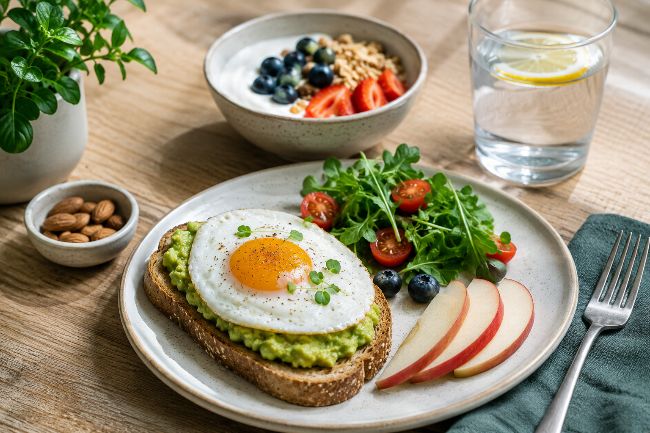
Reclaiming ownership of health does not require perfection. It simply requires greater intentionality. Small actions such as paying attention to food quality, prioritizing nutrient dense choices, and building sustainable routines can have a meaningful impact over the long term.
Perhaps the goal is not to reject convenience, but to use it wisely. When convenience and awareness work together, healthy habits become easier to maintain without sacrificing what matters most.

Conclusion
Convenience has transformed modern life in remarkable ways, helping people save time and manage increasingly busy schedules. However, as convenience becomes more deeply integrated into everyday routines, it is worth reflecting on how it influences our relationship with health and nutrition.
While many aspects of life can be outsourced, wellbeing remains deeply personal. Healthy eating habits, awareness, and consistency cannot be replaced by convenience alone. The most sustainable approach often involves finding ways to combine modern efficiency with intentional choices that support long term wellness.
Supporting Modern Nutrition with Nutrient Dense Choices
For those looking to incorporate more nutrient dense foods into a busy lifestyle, Chlorella Gold by Abeille d’Or offers a convenient option that complements a balanced approach to modern nutrition. Formulated with chlorella, CGF, iron, and B vitamins, it fits naturally into a wellness routine focused on consistency and nutritional awareness.