



Information Overload: How to Protect Your Attention in a Distracted World
Table of Contents
Introduction
The Attention Economy
Why More Information Does Not Always Mean Better Decisions
The Hidden Cost of Constant Notifications
Why Mental Clarity Requires Mental Space
Protecting Your Focus in a Distracted World
Deep Focus Is Becoming a Competitive Advantage
Reclaiming Control of Your Attention
Conclusion

Introduction
Never before in human history have people had access to so much information. News updates arrive instantly, messages appear throughout the day, social media platforms compete for attention, and digital devices ensure we are constantly connected. While technology has created incredible opportunities for learning, communication, and productivity, it has also introduced new challenges that many people did not anticipate.
One of the biggest challenges is attention. In a world where information is abundant, attention has become one of our most valuable resources. Every notification, advertisement, email, and headline competes for a limited amount of mental bandwidth. As a result, many people find themselves feeling mentally busy even when they have accomplished very little.
This constant exposure to information can affect more than productivity. It can influence how we think, make decisions, process information, and maintain mental clarity. Many individuals report feeling distracted, overwhelmed, or mentally fatigued despite having access to more tools and resources than ever before.
Understanding how information overload affects the brain is an important first step toward protecting focus and concentration in an increasingly distracted world.
The Attention Economy
Many modern digital platforms are designed around a simple principle: capturing and retaining attention. Social media apps, streaming services, news platforms, and countless online tools compete for engagement because attention has become a valuable currency in the digital economy.
This competition is not always obvious. Notifications are carefully designed to encourage interaction. Infinite scrolling features remove natural stopping points. Algorithms continuously deliver new content based on previous interests and behaviours. The result is an environment where distractions are constantly available.
While these technologies provide genuine benefits, they can also create a situation where attention is fragmented throughout the day. Instead of focusing deeply on one task, many individuals shift repeatedly between activities, conversations, and streams of information.
Over time, this pattern can make sustained focus increasingly difficult and contribute to feelings of mental exhaustion.
Why More Information Does Not Always Mean Better Decisions
It is easy to assume that having more information automatically leads to better outcomes. After all, knowledge is valuable. However, the relationship between information and decision making is not always straightforward.
The brain has limits when it comes to processing information. When faced with too many inputs, it can become overwhelmed. Rather than improving decision quality, excessive information may increase confusion, hesitation, and mental fatigue.
This phenomenon is sometimes referred to as analysis paralysis. Individuals spend so much time gathering information that they struggle to take action. Instead of creating clarity, additional information creates uncertainty because every new perspective introduces additional considerations.
In many situations, effective decision making depends not on consuming more information but on identifying the most relevant information and filtering out unnecessary noise.
The Hidden Cost of Constant Notifications
Notifications may seem harmless individually, but their cumulative effect can be significant. Each alert, vibration, or pop up message interrupts attention and requires the brain to shift focus. Even brief interruptions can disrupt concentration and reduce productivity.
Research on attention suggests that regaining focus after a distraction often takes longer than people realize. Although individuals may believe they are multitasking efficiently, the brain is actually switching between tasks rather than processing them simultaneously.
These frequent interruptions create cognitive friction. Mental energy that could be directed toward meaningful work is instead consumed by constant transitions. Over time, this can contribute to mental fatigue and reduced focus.
The challenge is not necessarily the existence of notifications. Rather, it is the volume and frequency with which they compete for attention throughout the day.

Why Mental Clarity Requires Mental Space
Many people assume that improving focus means learning to work harder. In reality, mental clarity often depends on creating space rather than increasing effort. The brain performs best when it has opportunities to process information without constant interruption.
Moments of quiet reflection play an important role in cognitive wellbeing. Activities such as walking, journaling, reading, or simply spending time away from screens can provide the brain with valuable opportunities to reset and organize thoughts.
Unfortunately, these moments are becoming increasingly rare. Many individuals fill every available moment with digital stimulation, leaving little room for reflection or mental recovery. Waiting in line, commuting, or taking a short break often involves checking a phone rather than allowing the mind to rest.
Creating mental space is not about avoiding technology entirely. It is about ensuring that periods of focus and recovery remain part of daily life.
Protecting Your Focus in a Distracted World
The good news is that attention can be protected. While it may not be possible to eliminate distractions completely, individuals can take practical steps to create an environment that supports focus and concentration.
One effective strategy is reducing unnecessary interruptions. Turning off nonessential notifications, setting specific times to check messages, and creating dedicated focus periods can help minimize attention fragmentation. Small adjustments often produce meaningful improvements.
Another useful approach involves designing physical environments that support concentration. A tidy workspace, reduced visual clutter, and clear boundaries between work and leisure activities can help signal to the brain when it is time to focus.
These strategies are not about perfection. They are about creating conditions that make sustained attention more achievable in everyday life.
Deep Focus Is Becoming a Competitive Advantage
As distractions become more common, the ability to focus deeply is becoming increasingly valuable. Individuals who can maintain concentration for extended periods often gain advantages in learning, problem solving, creativity, and professional performance.
Deep focus allows the brain to engage fully with complex tasks. Instead of constantly reacting to external inputs, individuals can direct their attention intentionally and produce higher quality work. This ability is becoming more important as modern careers increasingly depend on knowledge, creativity, and cognitive performance.
The challenge is that deep focus rarely happens by accident. It often requires intentional effort and environmental design. Protecting attention means actively choosing where mental energy is directed rather than allowing external forces to make those decisions.
In many ways, focus has become a skill that must be practiced and protected in the same way physical fitness requires ongoing maintenance.
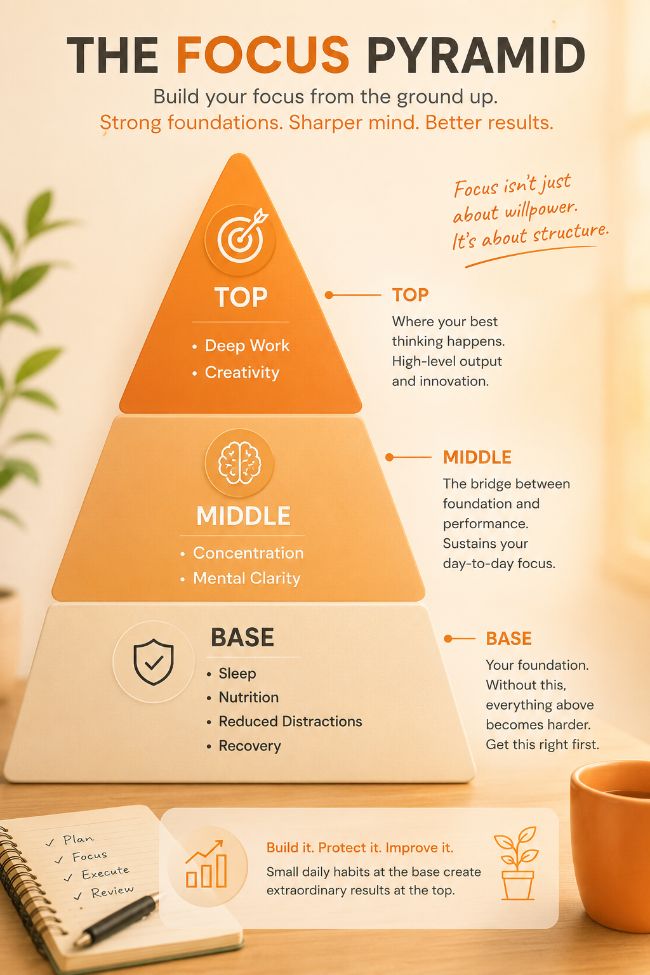
Reclaiming Control of Your Attention
One of the most empowering realizations about attention is that it remains within our influence. While the digital world is designed to compete for attention, individuals still have the ability to establish boundaries and make intentional choices about how they spend their mental energy.
This does not require abandoning technology or disconnecting from modern life. Instead, it involves becoming more aware of how attention is spent and ensuring that important priorities receive the focus they deserve. Small changes such as limiting unnecessary screen time, scheduling focused work sessions, or creating technology free moments can have a meaningful impact.
Attention is ultimately a reflection of priorities. The things we consistently focus on shape our experiences, learning, productivity, and wellbeing. Protecting attention is therefore not just a productivity strategy. It is an investment in overall quality of life.
As information continues to expand, the ability to manage attention effectively may become one of the most valuable skills of the modern era.
Conclusion
Information overload is one of the defining challenges of modern life. While access to knowledge has never been greater, the constant competition for attention can make it difficult to maintain focus, concentration, and mental clarity.
The solution is not to avoid information altogether but to become more intentional about how it is consumed. By reducing unnecessary distractions, creating mental space, and protecting periods of focused attention, individuals can build healthier relationships with technology and support long term cognitive wellbeing.
Supporting Your Cognitive Wellness Journey
For those looking to complement healthy lifestyle habits with nutritional support, IQ No.1 by Abeille d’Or contains bee pollen, royal jelly calcium, vitamin B complex, beta carotene, and rooibos tea extract as part of a formulation designed to support overall brain function, mental focus, and mood balance.