



Why Healthy People Make Fewer Decisions
Table of Contents

Introduction
When we think about healthy people, we often focus on what they do. We notice their exercise routines, eating habits, productivity, or commitment to self care. What we rarely notice is what they do not do. Specifically, they often spend less time deciding whether to make healthy choices in the first place.
Many people assume that maintaining a healthy lifestyle requires exceptional willpower. They imagine disciplined individuals constantly resisting temptations and making perfect decisions throughout the day. While self discipline certainly has value, research in behavioural psychology suggests that successful habits are often driven by something much simpler: reducing the number of decisions required.
The human brain makes thousands of decisions every day. Some are significant, while many are small and seemingly unimportant. What should I eat? Should I exercise today? Should I stay up later or go to bed now? Over time, these choices consume mental energy and create opportunities for inconsistency.
Healthy people are not necessarily better at making decisions. In many cases, they simply design their lives in a way that requires fewer decisions about healthy behaviours. Understanding this principle can provide valuable insights into building a sustainable wellness routine.
The Hidden Cost of Decision Fatigue
Every decision requires mental effort. Even simple choices consume cognitive resources, especially when they are repeated throughout the day. Psychologists refer to this phenomenon as decision fatigue, a state in which the quality of decision making gradually declines after prolonged periods of choosing between options.
Decision fatigue affects everyone. After a long day filled with work responsibilities, meetings, family obligations, and unexpected challenges, the brain naturally seeks ways to conserve energy. This is often when healthy intentions begin to weaken. Preparing a balanced meal may suddenly feel more difficult than ordering takeout. Exercising may seem less appealing than relaxing on the couch.
Importantly, decision fatigue is not a reflection of character or motivation. It is a normal response to cognitive overload. The more decisions people make, the harder it becomes to maintain consistent behaviour across all areas of life.
This helps explain why relying solely on willpower often fails. Even highly motivated individuals experience decision fatigue. The key difference is that healthy people often structure their environment to reduce the number of decisions they need to make.
Why Habits Are More Powerful Than Willpower
Popular culture often celebrates willpower as the ultimate solution to personal improvement. While determination can certainly help people overcome challenges, it is not always the most reliable strategy for long term success. Willpower fluctuates depending on stress levels, sleep quality, mood, and countless other factors.
Habits, on the other hand, operate differently. Once established, habits require significantly less conscious effort. The brain learns patterns through repetition and eventually performs certain behaviours automatically. This process reduces the need for constant decision making.
Consider brushing your teeth. Most people do not spend time debating whether they should brush their teeth every morning. The behaviour has become automatic through repetition. As a result, it requires very little mental energy.
Healthy individuals often apply this principle to multiple areas of life. By turning positive behaviours into routines, they reduce dependence on motivation and create systems that support consistency.
The Power of Environmental Design
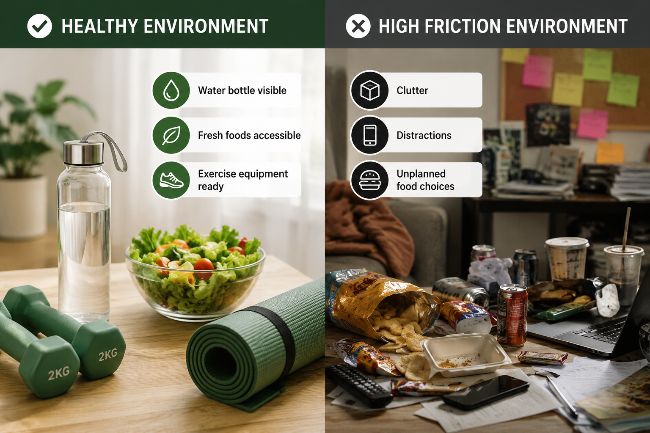
One of the most effective ways to reduce decision making is through environmental design. This concept refers to arranging surroundings in a way that encourages desired behaviours while minimizing obstacles.
For example, someone who wants to exercise regularly may place workout clothes in a visible location the night before. A person trying to drink more water may keep a water bottle within reach throughout the day. These small adjustments reduce friction and make healthy actions easier to perform.
The opposite is also true. Unhealthy choices often become more likely when they are the easiest option available. If highly processed snacks are visible and convenient while healthier foods require effort to access, the brain naturally gravitates toward the path of least resistance.
Healthy people frequently succeed not because they have greater self control, but because they create environments that support their goals. They make healthy choices easier and unhealthy choices less convenient.
Why Routines Reduce Stress
Many people view routines as restrictive, but routines can actually reduce stress by simplifying daily life. When certain actions become predictable, the brain spends less energy deciding what to do next.
Morning routines provide a useful example. Individuals who follow a consistent routine often start the day with greater clarity because they are not making dozens of decisions before breakfast. The routine creates structure, allowing mental energy to be directed elsewhere.
The same principle applies to wellness habits. When exercise, meal planning, hydration, or sleep schedules become part of a routine, they require less active decision making. This reduces cognitive load and increases the likelihood of consistency.
Rather than limiting freedom, routines often create it. They free the mind from repetitive decisions and provide a stable foundation for healthy living.
The Wellness Routine Advantage
Many successful health habits share one common characteristic: they are integrated into daily life. Instead of existing as separate tasks that require constant attention, they become part of a broader wellness routine.
This integration is important because isolated habits are easier to forget or postpone. When healthy behaviours are linked together, they reinforce one another. A person who follows a consistent morning routine may find it easier to maintain healthy eating habits, stay hydrated, and remain physically active throughout the day.
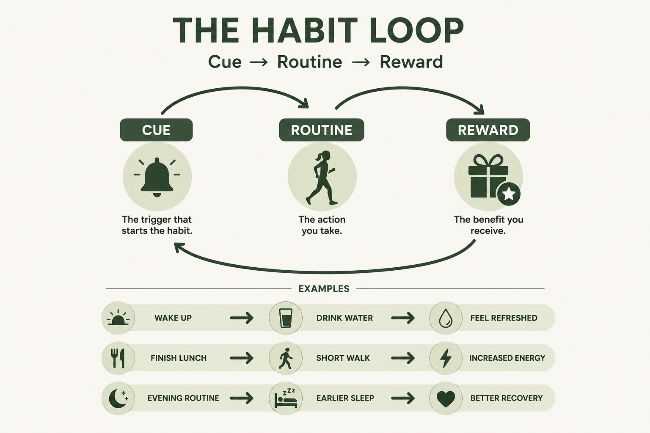
The concept is sometimes referred to as habit stacking. By attaching one behaviour to an existing routine, individuals create a chain of actions that become easier to maintain collectively. Over time, these routines require less effort and feel more natural.
The result is a lifestyle where healthy choices occur almost automatically rather than requiring continuous negotiation and decision making.
Making Healthy Choices Easier
One of the most valuable lessons in behavioural science is that behaviour often follows convenience. People are more likely to repeat actions that are simple, accessible, and easy to perform. This principle applies to nearly every aspect of life, including health.
Rather than asking how to become more disciplined, it can be more useful to ask how to make healthy choices easier. Small changes such as planning meals ahead of time, preparing healthy snacks, scheduling movement into the calendar, or creating a consistent bedtime routine can significantly reduce daily decision making.
These adjustments may seem minor, but they often produce meaningful results over time. By reducing friction, individuals increase the likelihood that healthy behaviours will occur consistently.
This perspective shifts the focus away from perfection and toward practicality. Healthy living becomes less about constant effort and more about designing systems that support success.
Health Is Often the Result of Fewer Decisions
When people observe someone who appears healthy, productive, and consistent, it is easy to assume that person possesses extraordinary discipline. In reality, they may simply have fewer opportunities to make unhealthy choices.
Their routines have removed many of the decisions that create inconsistency. They do not wake up wondering whether they should exercise. They do not spend excessive energy debating basic health habits. The decision has already been made through the structure of their daily routine.
This approach does not guarantee perfection, nor does it eliminate life’s challenges. However, it significantly increases the likelihood that healthy behaviours will occur consistently. Over months and years, these small advantages accumulate into meaningful outcomes.
The goal is not to control every aspect of life. The goal is to create enough structure that healthy choices become easier, more automatic, and more sustainable.
Conclusion
Healthy people are not necessarily making better decisions all day long. More often, they are making fewer decisions because their routines, habits, and environments already support healthy behaviours. By reducing decision fatigue and creating systems that encourage consistency, they make wellness feel less like a daily challenge and more like a natural part of life.
The good news is that anyone can apply these principles. Building a sustainable wellness routine does not require extraordinary motivation or willpower. It often begins with small adjustments that make healthy choices easier and more automatic over time.
Supporting Consistent Wellness Habits
For those looking to simplify their daily wellness routine, Green Kale by Abeille d’Or offers a convenient way to incorporate greens into a busy lifestyle, making one healthy choice easier to maintain consistently.