



Why Your Brain Loves Routine More Than Motivation
Table of Contents
Introduction
Motivation gets a lot of credit in the wellness world. We often hear stories about people who transformed their lives after finding the motivation to exercise, eat healthier, learn a new skill, or pursue a meaningful goal. As a result, many people spend a significant amount of time waiting for motivation to arrive before taking action.
The problem is that motivation is inherently unreliable. Some days we feel energized, focused, and ready to tackle challenges. Other days, even simple tasks can feel overwhelming. If our habits depend entirely on motivation, consistency becomes difficult because our behaviour fluctuates with our emotions, energy levels, and circumstances.
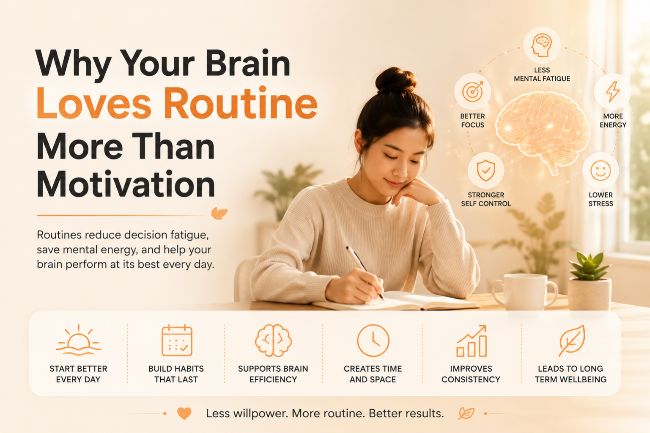
Interestingly, the human brain does not actually prefer constant decision making. In fact, it is designed to conserve energy whenever possible. This is one reason why routines and habits play such an important role in daily life. When actions become automatic, the brain can perform them with less effort and fewer mental resources.
Understanding why the brain responds so well to routine can help us build healthier habits, improve mental performance, and create more sustainable approaches to personal wellbeing.
The Myth of Waiting for Motivation
Many people believe successful individuals are simply more motivated than everyone else. Social media often reinforces this idea by showcasing moments of peak productivity, intense discipline, and apparent consistency. What is rarely shown are the ordinary days when motivation is low and distractions are plentiful.
The reality is that motivation is often a poor predictor of long term success. Motivation is emotional by nature. It rises and falls depending on mood, stress levels, sleep quality, environment, and countless other factors. Even highly accomplished individuals experience days when they would rather avoid difficult tasks.
This is why relying exclusively on motivation can create a cycle of inconsistency. People feel inspired, take action, make progress, then lose momentum when motivation fades. They eventually wait for another burst of inspiration before starting again. Over time, this pattern can feel frustrating and unsustainable.
The most successful habits are rarely built on motivation alone. They are built on systems that continue functioning even when motivation is absent.
Why the Brain Prefers Efficiency
The human brain is remarkably powerful, but it is also surprisingly efficient. Despite accounting for only a small percentage of body weight, the brain consumes a significant amount of energy each day. To manage this demand, it constantly looks for ways to conserve mental resources.
One of the ways the brain accomplishes this is through habit formation. When a behaviour is repeated often enough, the brain gradually shifts it from conscious effort to automatic behaviour. This allows actions to be performed with less mental energy and fewer decisions.
Think about activities such as brushing your teeth, locking your front door, or driving a familiar route. These tasks require very little conscious thought because they have become routine. The brain no longer needs to carefully evaluate each step because the pattern has already been established.
This efficiency is one reason routines are so valuable. They reduce cognitive workload and free up mental resources for more important decisions and challenges.
Decision Fatigue Is More Real Than You Think
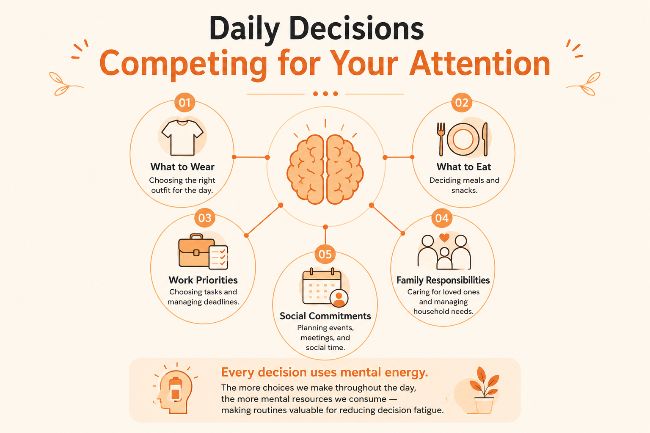
Every day, people make hundreds of decisions. Some are significant, while others seem trivial. What should I eat for breakfast? Should I exercise today? Which task should I tackle first? What should I cook for dinner? Over time, these decisions accumulate and place demands on mental energy.
Psychologists often refer to this phenomenon as decision fatigue. The more decisions a person makes throughout the day, the more difficult it can become to maintain focus, discipline, and good judgement. This is one reason people are more likely to make impulsive choices when they feel mentally exhausted.
Decision fatigue affects many areas of life, including health habits. After a long day of work, deciding whether to prepare a nutritious meal may feel much harder than ordering takeout. The issue is not necessarily a lack of knowledge. Often, it is simply mental exhaustion.
Routines help reduce this burden. By turning healthy behaviours into automatic actions, individuals can eliminate unnecessary decisions and preserve mental energy for more meaningful priorities.
Why Routines Create Mental Freedom
Many people assume routines are restrictive. They imagine schedules that are rigid, repetitive, and limiting. In reality, effective routines often create more freedom rather than less.
When certain behaviours become automatic, individuals spend less time debating whether they should perform them. They simply act. This reduces mental friction and creates more space for creativity, problem solving, and meaningful work.
For example, someone who follows a consistent morning routine does not need to negotiate with themselves every day about what to do first. Their routine provides structure, allowing them to start the day with greater clarity and less stress.
This principle extends beyond productivity. Health habits become easier to maintain when they are integrated into a routine rather than treated as daily decisions. The less mental effort required, the more sustainable the habit becomes.
Small Routines Shape Bigger Outcomes
Many people underestimate the impact of small daily behaviours because the results are not immediately visible. A healthy breakfast does not transform wellbeing overnight. One night of quality sleep does not solve every problem. Yet these actions matter because they contribute to long term patterns.
The brain responds strongly to repetition. Each time a behaviour is repeated, the neural pathways associated with that action become stronger. Over time, what initially required effort begins to feel more natural and automatic.
This is why small routines often produce surprisingly large outcomes. Reading a few pages each day can eventually lead to dozens of completed books. Taking a short daily walk can accumulate into hundreds of hours of movement each year. Small actions repeated consistently create momentum.
From a wellness perspective, this understanding is incredibly empowering. It shifts the focus away from dramatic transformations and toward sustainable habits that can realistically be maintained over time.
Building a Brain Friendly Lifestyle
Supporting brain health is not about chasing perfection. It is about creating an environment that encourages healthy behaviours and reduces unnecessary mental strain. Small adjustments to daily routines can often make a meaningful difference.
Consistent sleep schedules, regular movement, balanced nutrition, and intentional breaks all contribute to a healthier cognitive environment. These habits help support mental performance while reducing the mental effort required to make good decisions throughout the day.
Importantly, brain friendly routines do not need to be complicated. In many cases, the simplest habits are the most effective because they are easier to maintain. The goal is not to create a perfect schedule but to establish patterns that support long term wellbeing.
When routines become part of daily life, healthy choices begin to feel less like obligations and more like natural behaviours.

Consistency Beats Inspiration
Perhaps the most important lesson about motivation is that it was never meant to carry the entire burden of change. Motivation can help people get started, but consistency is what drives long term results. The brain responds more effectively to repeated behaviours than occasional bursts of effort.
This is why successful individuals often appear disciplined. What looks like discipline from the outside is frequently the result of well designed routines. They have reduced the number of decisions required to maintain productive behaviours and created systems that support consistency.
Waiting to feel motivated before taking action places too much responsibility on a temporary emotion. Building routines, on the other hand, creates a structure that supports action regardless of how a person feels on a particular day.
Over time, these routines become part of identity. Instead of someone who occasionally makes healthy choices, a person becomes someone who naturally follows habits that support their wellbeing. This shift often has a greater impact than motivation ever could.
Conclusion
Motivation may inspire action, but routine is what sustains it. The brain naturally seeks efficiency, which is why habits and routines often outperform willpower in the long run. By reducing decision fatigue and creating predictable patterns, routines make healthy behaviours easier to maintain.
Rather than waiting for the perfect moment or a surge of inspiration, it may be more effective to focus on building simple systems that support consistency. Small daily actions, repeated over time, can have a remarkable impact on wellbeing, productivity, and mental performance.
Supporting Your Daily Cognitive Wellness Routine
For those looking to complement healthy routines with nutritional support, IQ No.1 by Abeille d’Or contains bee pollen, royal jelly calcium, vitamin B complex, beta carotene, and rooibos tea extract as part of a formulation designed to support overall brain function, mental focus, and mood balance.