


Are You Eating Enough Vegetables, or Just Thinking You Are?
Table of Contents
Introduction
1. What Does Eating Enough Vegetables Actually Mean?
2. Your Breakfast Might Contain Fewer Vegetables Than You Think
3. A Vegetable Dish Is Not Always a Full Serving
4. The Vegetable Problem With Convenience Meals
5. Variety Matters, Not Just Quantity
6. Try Auditing One Ordinary Day of Eating
7. Making Vegetables a Habit Rather Than a Special Effort
Conclusion
Introduction
Think about everything you ate yesterday. Perhaps breakfast was a plate of nasi lemak with a few slices of cucumber, followed by chicken rice for lunch and a bowl of noodles for dinner. Somewhere along the way, there may have been a little sawi, some bean sprouts, or a spoonful of stir-fried vegetables. If someone asked whether you ate vegetables yesterday, you would probably say yes. Technically, you would be right. But were those small portions enough to contribute meaningfully to your daily vegetable intake?
For many Malaysians, vegetables are familiar ingredients rather than unfamiliar health foods. We grow up eating kangkung, kailan, cabbage, long beans, okra, sawi, and countless other greens. Vegetables appear in our soups, curries, mixed rice dishes, noodle meals, and home-cooked dinners. Yet the fact that vegetables appear somewhere in our meals does not necessarily mean we are eating enough of them throughout the day.
Part of the confusion comes from how we think about portions. We might consider a few cucumber slices beside nasi lemak to be our vegetables for breakfast, or assume that the handful of bean sprouts in char kway teow counts as a substantial serving. Without a clear understanding of what a vegetable serving actually looks like, it becomes surprisingly easy to overestimate how much we consume.
So rather than asking whether you eat vegetables, perhaps a more useful question is: how much of your daily plate is actually made up of vegetables? Understanding the difference between including vegetables and eating enough of them can help us make practical improvements without completely changing the Malaysian meals we already enjoy.
1. What Does Eating Enough Vegetables Actually Mean?
Vegetables provide dietary fibre, vitamins, minerals, and a variety of naturally occurring plant compounds that contribute to a balanced diet. Eating different types also helps introduce nutritional variety, which is one reason public-health guidance encourages regular vegetable consumption rather than relying on a single favourite.
Malaysia’s Healthy Plate concept, commonly known as Suku Suku Separuh, offers a useful visual starting point. It encourages people to imagine a plate divided into quarters and halves: one quarter for carbohydrate-rich foods, one quarter for protein-rich foods, and half for vegetables and fruit. This framework helps make balanced eating easier to understand without requiring detailed calorie calculations.
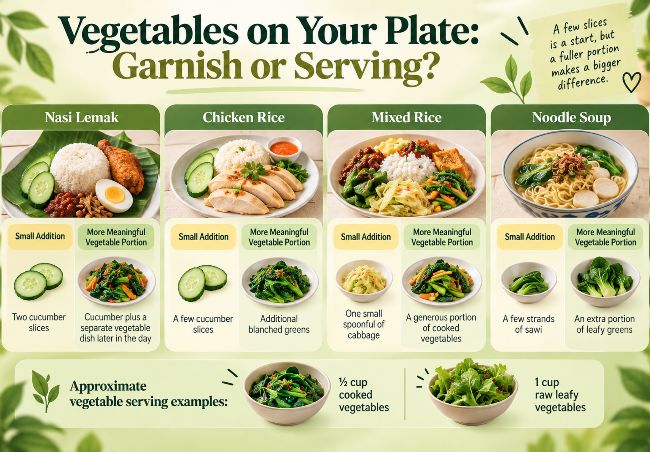
Malaysian dietary guidance also recommends at least three servings of vegetables daily, alongside two servings of fruit. The exact amount represented by a serving depends on the type and preparation of the vegetable. For example, a serving may be approximately half a cup of cooked vegetables or one cup of raw leafy vegetables. These are practical guides rather than a requirement to measure every mouthful.
The important distinction is between a garnish and a meaningful portion. A few cucumber slices or a scattering of bean sprouts certainly contribute something, but they may not add up to a full serving. Once we begin recognising portion sizes, it becomes easier to understand why a day that includes vegetables at several meals might still fall short of our intended intake.
2. Your Breakfast Might Contain Fewer Vegetables Than You Think
Breakfast is an interesting place to begin because many familiar Malaysian breakfast foods are built around carbohydrates, protein, or both. Roti canai, nasi lemak, toast with eggs, fried noodles, and kuih are popular for good reasons. They are convenient, satisfying, and deeply connected to everyday Malaysian food culture.
However, vegetables are not always a major part of these meals. Nasi lemak may include cucumber slices, while fried noodles might contain a little cabbage or bean sprouts. A breakfast of toast and eggs may contain no vegetables at all unless we deliberately add them.
This does not mean every breakfast needs to resemble a salad. It simply means recognising that breakfast may contribute relatively little towards our vegetable intake. If that is the case, lunch and dinner become important opportunities to include more substantial portions.
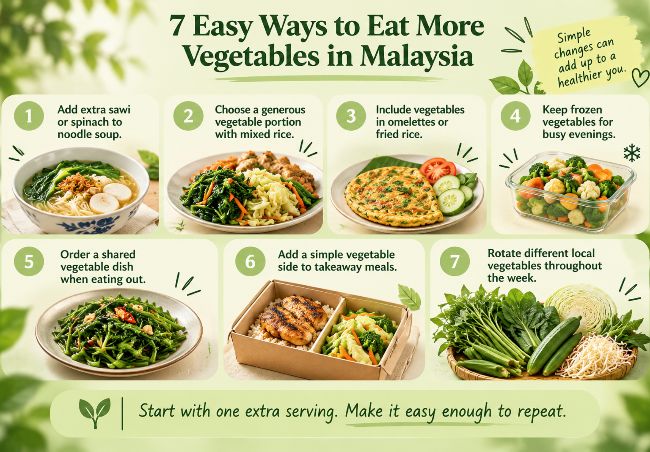
For those who prefer a savoury breakfast, vegetables can sometimes be added naturally. An omelette can include spinach or tomatoes, noodles can be prepared with extra leafy greens, and leftover vegetables from dinner can become part of the morning meal. Small adjustments are often easier to maintain than completely replacing familiar breakfast foods.
3. A Vegetable Dish Is Not Always a Full Serving
Lunch is often when vegetables become more visible, especially for people who eat mixed rice or economy rice. A typical selection might include rice, chicken or fish, and one vegetable dish. At first glance, that appears balanced because all the major food groups are represented.
But portion size still matters. A single spoonful of stir-fried cabbage may look substantial beside a large serving of rice, yet it may contribute less than we assume. Similarly, a few pieces of long beans mixed into a meat dish are not necessarily equivalent to a separate serving of vegetables.
This is where visual awareness can help. Instead of asking whether there is a vegetable dish on the plate, look at how much space the vegetables occupy. Are they a small addition at the edge, or do they form a noticeable portion of the meal?
There is no need to make every lunch perfect. Choosing a larger vegetable portion, adding a second vegetable dish when practical, or reducing the dominance of rice and other components can gradually improve the overall balance. The goal is to make vegetables a regular part of the meal rather than an afterthought.
4. The Vegetable Problem With Convenience Meals
Busy days can make vegetable intake less predictable. When lunch is rushed or dinner comes from a food delivery app, convenience often determines what ends up on the plate. Meals that are quick, filling, and easy to transport may not always contain generous vegetable portions.
Consider some common options. A takeaway fried rice may include a small amount of mixed vegetables, but the quantity can vary considerably. A burger meal may contain lettuce and tomato, yet these are usually modest additions. Instant noodles might contain dried vegetable pieces, which should not automatically be assumed to provide a substantial serving.
The issue is not that convenience foods must be avoided completely. For many Malaysians, they are part of navigating work schedules, commuting, childcare, and household responsibilities. The more useful question is how to make these meals more nutritionally complete when possible.
Sometimes the solution is straightforward. Add vegetables to noodles prepared at home, order an extra vegetable dish when sharing takeaway, keep washed vegetables available for quick meals, or include a simple vegetable side with dinner. Convenience and nutrition do not have to be opposites, but vegetables may require more deliberate attention when meals are chosen primarily for speed.
5. Variety Matters, Not Just Quantity
Once people begin thinking about vegetable portions, it is tempting to focus entirely on reaching a daily number. Quantity matters, but variety is also worth considering because different vegetables contribute different combinations of nutrients and plant compounds.
Malaysia offers plenty of opportunities for variety. Leafy greens such as sawi, spinach, kangkung, and kailan can be paired with vegetables such as carrots, cabbage, broccoli, okra, brinjal, and long beans. Different colours and textures can make meals more interesting while contributing to a more varied eating pattern.
Variety does not require buying an expensive collection of imported vegetables every week. Local produce, seasonal choices, and frozen vegetables can all be useful. What matters is choosing options that fit your budget, cooking preferences, and household needs.
It is also helpful to avoid treating one vegetable as nutritionally superior to every other. Kale, spinach, broccoli, and other vegetables can all contribute to a balanced diet, but no single vegetable provides everything the body needs. A practical approach is to rotate what you eat and enjoy a mixture of vegetables across the week.
6. Try Auditing One Ordinary Day of Eating
If you are unsure whether you eat enough vegetables, one of the simplest exercises is to review an ordinary day rather than a particularly healthy day. Think about what you actually eat on a typical working Tuesday, not what you plan to eat when you have more time.
Begin with breakfast. Were vegetables present? If so, were they a garnish or a substantial portion? Then consider lunch. Did you choose a separate vegetable dish, or were vegetables only mixed into another food? Finally, look at dinner and any snacks. By the end of the day, can you identify where your meaningful vegetable portions came from?
This exercise is not intended to produce guilt. Its purpose is awareness. Someone may discover that lunch provides most of their vegetables while breakfast and dinner contribute very little. Another person may realise that their home-cooked meals are reasonably balanced, but takeaway days contain fewer vegetables.
Once you notice the pattern, the solution becomes more specific. Instead of vaguely deciding to “eat healthier”, you can identify one meal where adding vegetables would be practical. A small, repeatable change is often more useful than an ambitious plan to redesign your entire diet.
7. Making Vegetables a Habit Rather Than a Special Effort
One reason vegetable intake can remain inconsistent is that we often rely on motivation. We decide to eat more vegetables, buy several types during a weekend grocery trip, and imagine preparing balanced meals throughout the week. But once normal responsibilities return, the plan can become difficult to maintain.
A more practical approach is to reduce the effort required. Keep vegetables that are easy to prepare, choose familiar recipes, and make them part of meals you already eat regularly. If you enjoy noodle soup, add more greens. If mixed rice is your usual lunch, make a vegetable dish part of your standard order. If you cook at home, prepare vegetables alongside the main dish rather than treating them as an optional extra.
Preparation can also make a difference. Washing and storing vegetables appropriately, keeping suitable frozen options available, or choosing vegetables with a longer storage life may reduce the chances of skipping them when time is limited. Convenience is not a failure of healthy eating. It can be one of the things that makes healthy eating possible.
It is equally important to remain flexible. Some days will include more vegetables than others, especially during travel, celebrations, or unusually demanding work schedules. The goal is not to count every leaf or turn meals into a mathematical exercise. It is to create a pattern where vegetables appear regularly and in meaningful portions.
Perhaps the most useful shift is to stop thinking of vegetables as something we add only when we are deliberately trying to be healthy. They can simply become an expected part of everyday meals, just like rice, noodles, or a source of protein. When that happens, improving vegetable intake begins to feel less like a special project and more like a normal part of eating.
Conclusion
Eating vegetables regularly and eating enough vegetables are not always the same thing. A few cucumber slices, a scattering of bean sprouts, or a small spoonful of cabbage may contribute to a meal, but they do not necessarily add up to the portions recommended for a balanced diet.
The encouraging part is that improving daily vegetable intake does not require abandoning Malaysian food or following an elaborate eating plan. Our local cuisine already includes an enormous variety of vegetables, from leafy greens and long beans to okra, cabbage, and many others. The opportunity is often simply to make them a more substantial and consistent part of our meals.
Rather than judging your diet based on whether vegetables appeared somewhere yesterday, try looking at the entire day. Consider the portions, the variety, and the meals where vegetables are frequently missing. Small improvements become easier when you know exactly where they are needed.
Healthy eating is not about creating the perfect plate every time. It is about building a routine that provides a better balance over time. And sometimes, the most useful place to begin is with a simple question: are vegetables genuinely part of my daily meals, or am I just assuming they are?
Making Daily Greens More Convenient
For those looking to complement their vegetable intake during busy days, Green Kale by Abeille d’Or provides the equivalent of four servings of kale per sachet, according to the brand’s product formulation information. It can be incorporated into a balanced eating routine alongside a variety of whole vegetables and other nutritious foods.