


Why Asking for Help Is a Sign of Strength, Not Weakness
Table of Contents
Introduction
1. Why We Have Learned to Associate Strength With Silence
2. Being Independent Does Not Mean Doing Everything Alone
3. The Hidden Cost of Always Saying “I’m Fine”
4. Asking for Help Can Look Different for Everyone
5. Learning to Listen Is Just as Important as Learning to Speak
6. Everyday Habits Still Matter for Emotional Wellbeing
7. Creating a Malaysia Where Asking for Help Feels Normal
Conclusion
Introduction
In Malaysia, there is a familiar answer we often give when someone asks how we are doing: “Okay lah.” It is simple, polite, and usually enough to keep the conversation moving. We say it at work, during family gatherings, over lunch with friends, and sometimes even to the people closest to us. But behind those two words, there can be a very different story. We might be overwhelmed by responsibilities, struggling with personal worries, or simply feeling emotionally exhausted. Yet admitting that things are difficult can sometimes feel harder than continuing to say everything is fine.
Many of us grow up believing that strength means being able to handle whatever life throws at us. We admire people who work hard without complaining, parents who sacrifice quietly for their families, and individuals who remain composed even during difficult circumstances. These qualities can reflect genuine resilience, but they can also create an unspoken expectation that strong people should be able to manage everything independently. When asking for help begins to feel like admitting defeat, emotional struggles can become unnecessarily isolating.
World Mental Health Day, observed every year on 10 October, offers an opportunity to reconsider that belief. Mental wellbeing is not simply about feeling happy or staying positive. It also involves recognising our emotions, navigating life’s challenges, maintaining meaningful relationships, and knowing when additional support may be necessary. Just as we would seek professional advice for a persistent physical health concern, emotional difficulties sometimes deserve attention beyond what we can manage alone.
Perhaps one of the most important conversations we can have this October is about redefining strength. What if being strong does not always mean holding everything together? What if it also means recognising our limits, expressing what we need, and allowing others to support us? Asking for help is not the opposite of resilience. Sometimes, it is one of the ways resilience begins.
1. Why We Have Learned to Associate Strength With Silence
For many people, the idea of being strong is closely connected to independence. From a young age, we are encouraged to solve problems, fulfil responsibilities, and avoid becoming a burden to others. These lessons can help us develop confidence and responsibility, but they may also influence how comfortable we feel expressing emotional needs.
In Malaysian families, this can sometimes appear through everyday expressions such as “be strong”, “don’t think too much”, or “other people have it worse”. These statements are often offered with good intentions. Family members may genuinely want to encourage someone through a difficult experience. However, when encouragement becomes the only response to emotional distress, people may begin to feel that their feelings are inconvenient or inappropriate.
The pressure can become stronger during adulthood. Employees may worry that admitting they are struggling will make them appear incapable. Parents may believe they must always remain composed for their children. Young adults may hesitate to discuss uncertainty because everyone around them seems to be progressing confidently. Over time, silence can become a habit rather than a conscious decision.
But emotional strength does not require the absence of vulnerability. A person can be responsible, capable, and resilient while still needing reassurance, guidance, or professional support. Recognising this distinction allows us to move away from the idea that managing everything alone is the ultimate measure of personal strength.
2. Being Independent Does Not Mean Doing Everything Alone
Independence is generally viewed as a positive quality. It allows us to make decisions, take responsibility, and navigate everyday challenges. But there is a difference between healthy independence and believing that we should never rely on anyone.
Consider how we approach other areas of life. We consult financial professionals when facing complicated financial decisions, ask colleagues for assistance with unfamiliar tasks, and seek medical advice when physical symptoms require attention. We do not automatically interpret these actions as weakness. Instead, we recognise that different situations require different kinds of knowledge and support.
Emotional wellbeing deserves the same perspective. Talking to a trusted friend, asking a family member for assistance, or consulting a qualified mental health professional can help us understand challenges from another angle. Support does not necessarily remove a problem, but it may make that problem easier to approach.
Healthy independence includes knowing what we can manage ourselves and recognising when additional help would be beneficial. Rather than reducing our ability to cope, appropriate support can become part of how we navigate responsibilities and maintain meaningful connections with others.
3. The Hidden Cost of Always Saying “I’m Fine”
Saying “I’m fine” is not always dishonest. Sometimes we simply do not want to discuss something personal, and everyone deserves the right to choose when and with whom they share their feelings. Privacy is important, and emotional openness should never become an obligation.
However, difficulties can arise when we feel unable to express ourselves even when we genuinely need support. Someone experiencing prolonged stress may continue attending work, completing household responsibilities, and participating in social activities while privately feeling overwhelmed. From the outside, everything may appear normal.
Over time, consistently ignoring emotional needs can make it harder to recognise when something requires attention. Stress may affect sleep, concentration, relationships, or our ability to enjoy everyday activities. These experiences do not automatically indicate a mental health condition, but they can be signals that our current way of coping deserves reconsideration.
Sometimes the first step is simply replacing an automatic answer with a more accurate one. Instead of saying everything is fine, we might tell someone we trust, “I’ve been having a difficult week,” or “There’s something on my mind.” Small moments of honesty can create opportunities for understanding without requiring us to share more than we feel comfortable revealing.
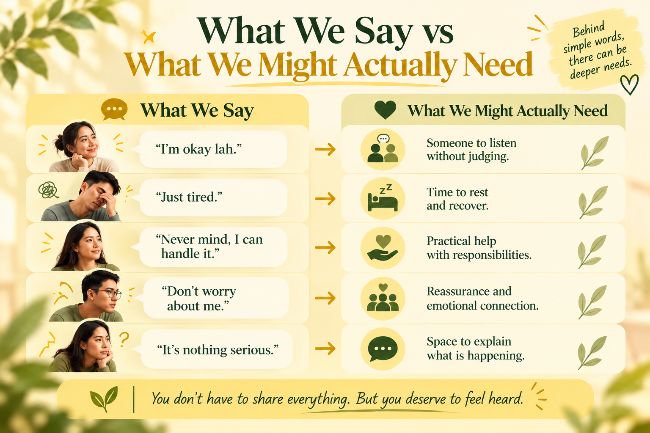
4. Asking for Help Can Look Different for Everyone
When people hear the phrase “seek help”, they may immediately imagine formal counselling or therapy. Professional mental health support can be important, particularly when difficulties are persistent, severe, or affecting daily functioning. But seeking support can also begin in smaller, everyday ways.
For one person, it might mean talking honestly with a close friend. For another, it could involve asking a partner to share household responsibilities or telling a manager that a workload has become difficult to manage. A university student might approach a campus counsellor, while a parent might reach out to relatives for practical assistance.
The important consideration is whether the support is appropriate for the situation. Friends and family can offer empathy, companionship, and practical help, but they cannot always provide the assessment or treatment that a qualified professional can. Recognising the difference helps ensure that emotional difficulties receive suitable attention.
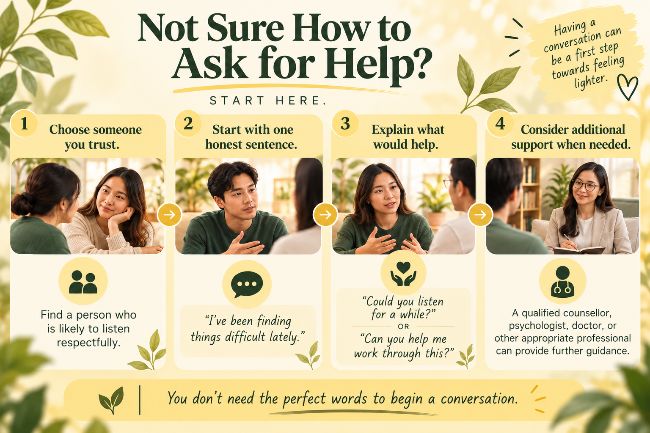
Asking for help also does not require a perfectly prepared explanation. Sometimes saying, “I’m not sure how to explain what I’m feeling, but I’d like to talk,” is enough to begin. We do not need to understand every emotion before allowing someone to support us.
5. Learning to Listen Is Just as Important as Learning to Speak
Encouraging people to ask for help is only part of the conversation. We also need to consider what happens when someone actually reaches out. If the response is dismissive, impatient, or overly judgmental, that person may become less willing to share again.
Listening sounds simple, but many of us instinctively try to solve problems as quickly as possible. When someone describes a difficult situation, we may immediately offer advice, compare it with our own experiences, or explain why things are not as bad as they seem. Although these reactions are often well-intentioned, they may leave the person feeling misunderstood.
Supportive listening can begin with curiosity rather than correction. Asking, “Would you like me to listen, or would you prefer some advice?” gives the other person an opportunity to express what they need. Acknowledging their feelings without immediately trying to change them can also make conversations feel safer.
This matters in families, friendships, schools, and workplaces. A culture of emotional wellbeing is not created simply by encouraging people to speak up. It also requires environments where people can reasonably expect to be treated with respect when they do.
6. Everyday Habits Still Matter for Emotional Wellbeing
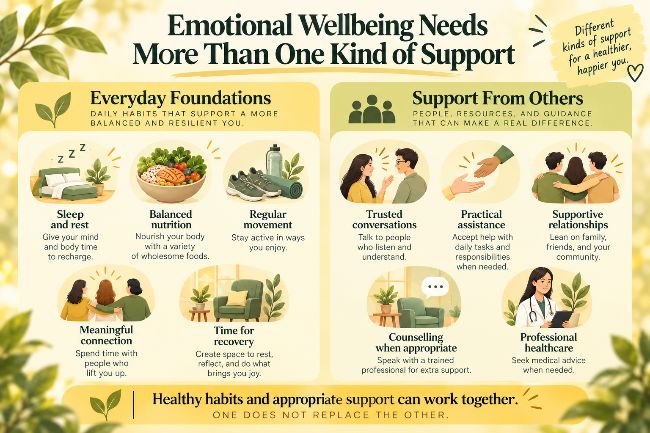
Seeking emotional support and maintaining healthy lifestyle habits are not competing approaches. Both can contribute to overall wellbeing, although everyday habits should never be presented as substitutes for appropriate mental healthcare.
Sleep is one familiar example. After several nights of insufficient rest, ordinary frustrations can feel more difficult to manage. Concentration may become harder, patience may decrease, and everyday responsibilities may require more effort. Protecting sleep therefore deserves attention as part of general wellbeing.
Movement, balanced nutrition, time outdoors when conditions are suitable, and meaningful social interaction can also form part of a supportive daily routine. These habits do not guarantee emotional stability, nor can they eliminate difficult circumstances. Their value lies in helping us maintain a healthier foundation while navigating the demands of everyday life.
It is equally important not to turn wellness into another source of pressure. Someone experiencing emotional difficulties may already feel overwhelmed. A realistic routine might begin with regular meals, a short walk, or a consistent bedtime rather than an ambitious programme of self-improvement. The goal is support, not perfection.
7. Creating a Malaysia Where Asking for Help Feels Normal
Mental wellbeing is often discussed as an individual responsibility. We encourage people to manage stress, develop resilience, and practise self-care. These messages have value, but they overlook the influence of the environments in which people live and work.
Imagine a workplace where employees can discuss unrealistic workloads without automatically being judged as incapable. Imagine families where children and adults can talk about difficult emotions without being told to stop overthinking. Imagine friendships where asking for support feels as normal as asking someone to join us for a meal.
These changes do not require everyone to become a mental health expert. They begin with everyday behaviours: listening more carefully, respecting privacy, avoiding unnecessary judgment, recognising personal boundaries, and understanding that professional help can be appropriate when someone needs it.
Malaysia’s diverse communities and strong social traditions offer many opportunities for connection. Family gatherings, neighbourhood relationships, friendships, and community activities can all create spaces where people feel less alone. The challenge is to make those connections emotionally supportive as well as socially familiar.
Perhaps a healthier understanding of strength begins here. Instead of celebrating only the people who appear to carry everything without assistance, we can also respect those who recognise their needs and take appropriate steps to address them. A supportive society is not one where nobody struggles. It is one where struggling does not automatically mean facing everything alone.
Conclusion
For too long, strength has sometimes been confused with silence. We admire people who remain composed under pressure, fulfil their responsibilities, and continue moving forward despite difficulties. But resilience is not measured solely by how much someone can endure without assistance.
Emotional wellbeing involves recognising that we are human. We have limits, experience difficult periods, and sometimes need reassurance, practical help, or professional guidance. None of these needs automatically makes us less capable or less independent.
This World Mental Health Day, perhaps we can begin with a simple change in perspective. Instead of asking why someone cannot manage everything alone, we can ask what kind of support might help. Instead of assuming that being strong means never struggling, we can recognise the courage involved in speaking honestly about a difficult experience.
A healthier Malaysia is not only one where people understand the importance of mental wellbeing. It is also one where asking for help feels normal, listening is taken seriously, and people know that they do not always have to face life’s challenges by themselves.
Supporting Your Everyday Wellness Routine
Alongside adequate rest, balanced nutrition, meaningful relationships, and appropriate emotional support, maintaining a consistent wellness routine can contribute to general wellbeing. For those looking to complement their daily nutrition, IQ No.1 by Abeille d’Or contains bee pollen, royal jelly calcium, vitamin B complex, beta carotene, and rooibos tea extract, formulated to support brain function, mental focus, and mood balance. It is not a treatment for mental health conditions or a substitute for professional care.