


Why Do We Feel Guilty When We Rest?
Table of Contents
Introduction
1. When Being Busy Becomes Part of Our Identity
2. Why Rest Can Feel Like Something We Must Earn
3. Not All Rest Looks the Same
4. The Problem With Turning Rest Into Another Task
5. Our Phones Can Make Switching Off More Difficult
6. Rest Can Support a More Sustainable Lifestyle
7. Learning to Rest Without Apologising
Conclusion
Introduction
Imagine this: it is a Sunday afternoon in Malaysia. The laundry is done, lunch is over, and for once, there is nothing urgent demanding your attention. You settle onto the sofa, ready to enjoy a quiet hour. But within minutes, a familiar thought appears. Shouldn’t you be doing something productive? Perhaps you could clean the kitchen, organise your wardrobe, reply to a few work messages, or finally complete that task you have been postponing. Suddenly, doing nothing feels strangely uncomfortable.
For many people, rest is no longer as simple as stopping an activity. Even when the body is sitting still, the mind continues running through unfinished responsibilities. We may feel guilty about taking a break while others are working, uncomfortable about spending time on ourselves, or worried that slowing down means falling behind. What should be a natural part of everyday life becomes something we feel we must justify.
This relationship with rest is especially interesting in a society that values hard work, responsibility, and perseverance. Many Malaysians balance demanding jobs, long commutes, household responsibilities, family expectations, and personal ambitions. Being busy can become so familiar that an empty space in the schedule feels less like freedom and more like a problem that needs to be solved.
But why have we become so uncomfortable with something our bodies and minds naturally need? Rest is not simply a reward for completing every responsibility. It is part of maintaining our ability to function, participate in life, and care for ourselves over time. Perhaps the real challenge is not learning how to rest, but unlearning the belief that we must earn the right to do so.
1. When Being Busy Becomes Part of Our Identity
Ask someone how life has been lately, and there is a good chance the answer will involve being busy. Busy with work. Busy with the children. Busy preparing for something. Busy catching up on responsibilities. Sometimes, busyness becomes such a normal part of conversation that we barely question what it means.
There is nothing inherently wrong with having a full schedule. Work, family, education, and personal goals can provide purpose and satisfaction. The difficulty begins when being busy becomes closely connected to how we measure our worth. If productivity makes us feel useful, capable, or successful, then moments without visible achievement can begin to feel uncomfortable.
This is particularly noticeable when people compare their lives with others. A colleague seems to be advancing quickly in their career. A friend is starting a business. Someone online is exercising before sunrise, preparing healthy meals, and learning a new skill after work. Even during personal downtime, we may feel that other people are making better use of their time.
Over time, this can create an unhelpful belief: if we are not accomplishing something, we are wasting time. Rest becomes difficult not because we have forgotten how to sit down, but because we have attached so much meaning to constantly doing something.
2. Why Rest Can Feel Like Something We Must Earn
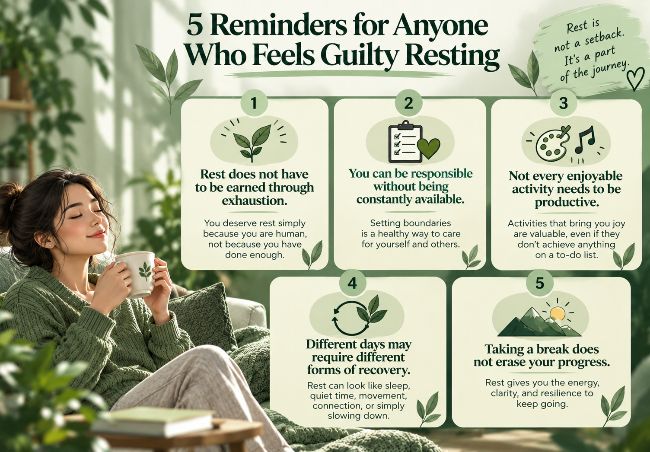
Think about the language we use around rest. We tell ourselves that we will relax once the work is finished, take a holiday after reaching a target, or enjoy a quiet weekend when the house is finally organised. Rest is frequently positioned at the end of a long list of responsibilities.
The problem is that everyday life rarely provides a completely empty to-do list. There is always another email, another household task, another appointment to arrange, or another responsibility waiting for attention. If rest is permitted only after everything has been completed, it can remain permanently out of reach.
For people caring for children, older parents, or other family members, the situation can be even more complicated. Taking time for themselves may feel selfish, particularly when someone else still needs attention. The belief that responsible people should always be available can make personal recovery feel like a luxury.
A healthier perspective is to recognise that rest is not the opposite of responsibility. It is one of the conditions that helps us continue meeting responsibilities sustainably. We do not expect a phone to operate indefinitely without recharging, yet we sometimes expect ourselves to remain available, productive, and emotionally present without allowing enough time to recover.
3. Not All Rest Looks the Same
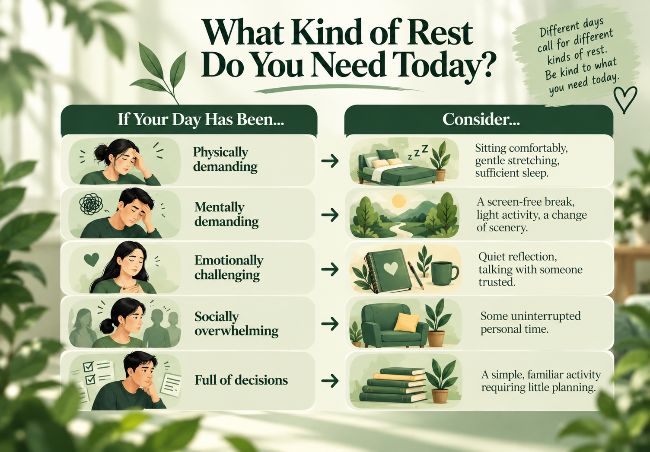
When we hear the word “rest”, we often imagine sleeping, lying down, or spending a quiet afternoon at home. These can be valuable forms of recovery, but rest is not limited to physical stillness. Different demands can leave us needing different kinds of breaks.
After a physically demanding day, sitting comfortably or sleeping may be exactly what we need. After several hours of intense concentration, however, a change of activity may feel more refreshing. Taking a gentle walk, preparing a simple meal, or spending time away from screens can provide a different experience from continuing to sit at a desk.
Social demands matter too. Someone who spends the entire working day speaking to customers, attending meetings, or managing other people’s needs may appreciate a little quiet time alone. Another person who works independently may find that meeting a friend for coffee provides a welcome sense of connection.
This is why copying someone else’s ideal rest routine does not always work. A relaxing activity for one person may feel tiring to another. Understanding what has been demanding about your day can help you choose a form of recovery that genuinely suits your needs.
4. The Problem With Turning Rest Into Another Task
Modern wellness culture has introduced many helpful ideas about self-care. Unfortunately, it has also made relaxation surprisingly complicated. There are elaborate morning routines, productivity systems, meditation challenges, sleep-tracking devices, and carefully planned weekend recovery schedules.
These tools may be useful for some people, but they can also create pressure to rest correctly. A person might begin to feel that a break only counts if it includes meditation, journaling, exercise, or another activity that produces a measurable benefit. What began as self-care can quietly become another performance goal.
Consider a simple evening at home. Instead of enjoying an hour of reading, someone may worry about whether they should be doing something more beneficial. Instead of taking a walk for pleasure, they may focus entirely on step counts. Even hobbies can become projects that require progress, improvement, or public sharing.
Rest does not always need an objective. Some experiences are worthwhile simply because they are enjoyable, calming, or meaningful. Watching the rain from your window, listening to music, enjoying a leisurely meal, or spending time with family does not require a productivity justification.
5. Our Phones Can Make Switching Off More Difficult
For many Malaysians, the smartphone is the first thing we reach for in the morning and one of the last things we look at before sleeping. It connects us to work, family, friends, entertainment, news, shopping, and almost every part of everyday life.
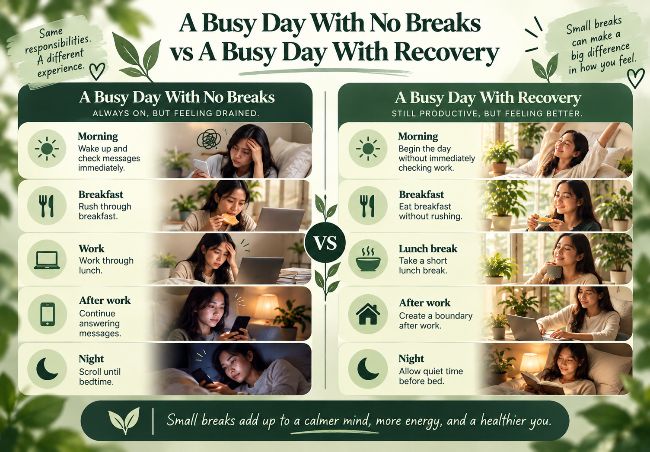
This convenience can make the boundary between activity and rest less clear. Someone may finish work at six in the evening but continue receiving messages throughout dinner. Another person may sit down to relax, only to spend the next hour moving between social media, news updates, shopping apps, and group conversations.
There is nothing wrong with enjoying digital entertainment. The question is whether our screen time is providing the experience we actually want. Sometimes scrolling is relaxing. At other times, it leaves us feeling more distracted, overstimulated, or aware of responsibilities we were trying to set aside.
Creating small boundaries can help. Silencing non-essential notifications during meals, setting aside short periods without work messages when feasible, or choosing an activity that does not involve a screen may make downtime feel more intentional. The goal is not to reject technology, but to give ourselves the option of being temporarily unavailable.
6. Rest Can Support a More Sustainable Lifestyle
Healthy living is often described through the things we should do more of. Eat more vegetables. Move more regularly. Drink enough water. Stay organised. Build better routines. These are useful goals, but the conversation can become unbalanced if it focuses entirely on adding activities.
Rest and recovery deserve a place alongside nutrition and movement. Adequate sleep supports everyday functioning, while appropriate breaks can help us manage periods of sustained effort. Time away from constant responsibilities also creates opportunities for relationships, hobbies, and experiences that make life enjoyable.
A sustainable routine therefore needs to consider both activity and recovery. Someone who exercises regularly but consistently sacrifices sleep may need to reconsider their schedule. Someone who spends every weekend catching up on work may benefit from protecting some personal time. Someone who is always available to others may need to establish reasonable boundaries.
The aim is not to spend every available moment resting. It is to recognise that wellbeing requires balance. A routine that leaves no space for recovery may become difficult to maintain, even when its individual activities appear healthy.
7. Learning to Rest Without Apologising
Changing our relationship with rest may require more than adjusting our schedules. It can also mean reconsidering the beliefs we have developed about productivity, responsibility, and personal worth.
One useful starting point is to notice the thoughts that appear when we stop working. Do we immediately feel that we should be doing something else? Do we compare ourselves with people who seem busier? Do we believe we need to explain why we are taking a break? Recognising these patterns can help us question whether they are genuinely useful.
It can also help to make rest a normal part of the schedule rather than something left over at the end. This does not mean every break needs to be planned precisely. It simply means acknowledging that personal time deserves consideration alongside work, errands, and family commitments.
Perhaps the most meaningful change is learning to value ourselves beyond what we accomplish. We are not only employees, parents, students, caregivers, or people with responsibilities to fulfil. We are also individuals who need enjoyment, connection, quiet, and opportunities to recover.
Resting without guilt may not happen immediately, particularly for people who have spent years associating busyness with success. But the more we treat recovery as a normal part of life, the less we may feel the need to defend it. We can begin to understand that taking care of ourselves is not time stolen from a meaningful life. It is part of making that life sustainable.
Conclusion
Rest should be one of the most natural parts of everyday life, yet many of us have learned to approach it with guilt. We worry about unfinished responsibilities, compare our productivity with others, and sometimes feel that taking a break requires an explanation.
But being busy is not the only measure of a meaningful life. Work, family responsibilities, and personal goals matter, but so do quiet moments, enjoyable experiences, meaningful relationships, and time to recover. A life filled entirely with obligations can leave little room to appreciate the things those obligations are meant to support.
Learning to rest does not mean abandoning ambition or becoming less responsible. It means recognising that effort and recovery belong together. Some days will naturally be demanding, while others may offer more space to slow down. Both can be part of a balanced lifestyle.
Perhaps the next time you find yourself sitting quietly on a Sunday afternoon, you can resist the urge to immediately fill the silence with another task. Not every moment needs to produce something. Sometimes, being present and allowing yourself to rest is enough.
Supporting Your Everyday Wellness Routine
Alongside adequate rest, balanced meals, regular movement, and other healthy lifestyle habits, maintaining consistent nutrition can be part of caring for your overall wellbeing. For those looking to complement their daily diet, Chlorella Gold by Abeille d’Or contains chlorella, CGF, iron, and B vitamins and can be incorporated into an everyday nutritional wellness routine.