


Why Your Health Shouldn’t Depend on Having Free Time
Table of Contents
Introduction
1. The Myth of the Perfect Time to Get Healthy
2. Why Healthy Habits Need to Fit Your Actual Life
3. Small Habits Work Best When They Have a Clear Place
4. Healthy Eating Shouldn’t Require Hours in the Kitchen
5. Movement Does Not Have to Be a Separate Event
6. Make the Healthy Choice the Convenient Choice
7. The Most Sustainable Routine Has Room for Imperfect Days
Conclusion
Introduction
It is Monday morning, and your day is already moving faster than expected. You wake up a little later than planned, rush through breakfast, and spend the next hour navigating traffic on the way to work. By lunchtime, several unexpected tasks have appeared, and the healthy meal you intended to prepare has been replaced by whatever is quickest to order. After work, there are groceries to buy, family responsibilities to manage, and messages that still need answering. By the time you finally sit down, taking care of your health feels like something that will have to wait until tomorrow.
For many Malaysians, this is not an unusually difficult day. It is simply an ordinary weekday. Between work schedules, commuting, household responsibilities, and personal commitments, free time can feel unpredictable. We often imagine that healthier living will become easier once our schedules settle down. Perhaps we will start exercising after a major project ends, cook more nutritious meals when work becomes less demanding, or finally establish a proper wellness routine during the next holiday.
The problem is that life rarely provides the perfect opening we are waiting for. One responsibility ends, another begins, and the free time we expected never quite appears. Months can pass while our health goals remain on hold, not because we lack interest in wellbeing, but because our plans depend on circumstances that are difficult to control.
What if the solution is not to wait for more free time, but to rethink how healthy living fits into the time we already have? A sustainable wellness routine should not require life to become less busy before it can begin. It should be flexible enough to exist alongside the responsibilities, interruptions, and unexpected demands of everyday life.
1. The Myth of the Perfect Time to Get Healthy
Many health goals begin with a future promise. We tell ourselves that we will start eating better next month, exercise regularly after the school holidays, or focus on our wellbeing once an important deadline has passed. These promises often feel reasonable because we genuinely expect our circumstances to improve.
Yet the perfect time can be surprisingly difficult to find. Workplaces experience busy periods throughout the year. Families have changing needs. Financial responsibilities, celebrations, travel, and unexpected events can all disrupt even the most carefully planned schedules. Waiting for a completely calm period may mean postponing healthy habits indefinitely.
Part of the problem is how we imagine healthy living. We may picture an ideal morning that includes exercise, a freshly prepared breakfast, meditation, and enough time to leave home without rushing. If our actual mornings look nothing like that, we might conclude that a wellness routine is simply unrealistic for us.
But healthy living does not have to resemble an idealised schedule. Someone who cannot exercise for an hour may still find opportunities for shorter periods of movement. A person who rarely cooks elaborate meals can still make thoughtful choices when eating out. Progress becomes more realistic when we stop treating perfect conditions as a requirement.
2. Why Healthy Habits Need to Fit Your Actual Life
A routine is only useful if it can be maintained under ordinary circumstances. It is easy to design an impressive wellness plan during a quiet weekend, but the real test comes on a busy Tuesday when meetings run late, traffic is heavy, and dinner needs to be prepared quickly.
This is why understanding your existing schedule matters more than copying someone else’s routine. A person working regular office hours may have different opportunities from someone managing shift work. Parents with young children face different demands from university students or retirees. Even within the same household, individuals may have very different energy levels and responsibilities.
Instead of beginning with what an ideal healthy person should do, consider what is realistically possible in your own day. When do you usually eat? How much time do you spend commuting? Which activities already happen consistently? Where do small opportunities exist without creating additional stress?
This approach shifts the focus from discipline to design. Rather than repeatedly forcing yourself to follow a routine that clashes with your lifestyle, you build habits around patterns that already exist. Healthy living becomes less about finding extra hours and more about making everyday activities work a little better for your wellbeing.
3. Small Habits Work Best When They Have a Clear Place
One reason healthy intentions are difficult to maintain is that they often remain vague. We decide to move more, drink more water, or eat better, but never determine exactly when or how those actions will happen. As a result, they depend on us remembering them during an already demanding day.
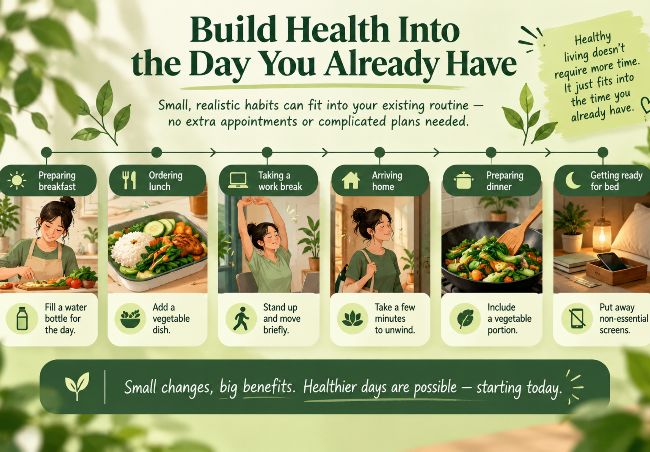
A practical alternative is to connect a new habit to something familiar. If you already prepare breakfast every morning, that routine might become a reminder to fill your water bottle. If you regularly take a lunch break, you could use that moment to include a vegetable dish. If you spend time waiting for your children after school, you might occasionally use part of that period for a short walk when the surroundings are suitable.
The advantage is that the existing activity provides a natural reminder. You do not need to create an entirely new schedule or rely on constant motivation. Over time, the healthier choice can become associated with a routine you already perform.
Of course, not every habit will fit neatly into an existing activity, and some days will still be unpredictable. The goal is not to create a rigid system that must always be followed. It is to make healthy choices easier to remember and more convenient to repeat, especially when life becomes busy.
4. Healthy Eating Shouldn’t Require Hours in the Kitchen
For many people, nutrition is one of the first areas affected by a demanding schedule. When time is limited, convenience becomes important. Meals may come from a nearby kopitiam, a mixed rice stall, a food court, or a delivery service rather than a carefully planned home kitchen.
It is easy to assume that eating well requires preparing every meal from scratch. Social media can reinforce this impression with images of perfectly organised meal-preparation containers, colourful breakfasts, and elaborate recipes. While home cooking can be useful, it is not the only way to build a balanced eating pattern.
Malaysian food culture provides many opportunities to make practical choices outside the home. A mixed rice meal can include a substantial vegetable portion and a protein source. A noodle soup can be ordered with extra greens when available. A simple meal at home can combine rice, eggs or another protein source, and vegetables without requiring complicated preparation.
Planning also does not need to be extensive. Keeping a few familiar, convenient ingredients available can make busy evenings easier. The objective is not to eliminate takeaway meals or achieve perfect nutrition every day. It is to create enough reliable options that a demanding schedule does not automatically mean abandoning balanced eating.
5. Movement Does Not Have to Be a Separate Event
When people think about becoming more active, they often imagine joining a gym, attending exercise classes, or setting aside a dedicated hour for workouts. These activities can be enjoyable and beneficial, but they are not the only opportunities for movement.
Everyday movement can happen in smaller ways. Walking during part of a lunch break, using stairs when appropriate, moving around between long periods of sitting, or taking a short evening walk can help make activity a more regular part of the day. These actions may seem modest, but they can be easier to repeat than an ambitious schedule that constantly competes with other commitments.
It is important to distinguish between general daily movement and the broader physical activity recommendations that support health. Short activity breaks are useful, but they do not necessarily replace the need for sufficient moderate or vigorous activity and muscle-strengthening exercise over time. Adults can work towards recommended activity levels gradually, according to their abilities and health circumstances.
For someone who currently spends much of the day sitting, the first goal might simply be to interrupt prolonged sedentary periods more often. As confidence and opportunities increase, longer walks, recreational activities, or structured exercise can be introduced. A flexible approach makes movement more accessible without suggesting that every small activity provides identical benefits.
6. Make the Healthy Choice the Convenient Choice
Our surroundings influence many of our everyday decisions. When something is easy to access, we are generally more likely to choose it. When an activity requires several extra steps, it becomes easier to postpone, especially when we are tired or distracted.
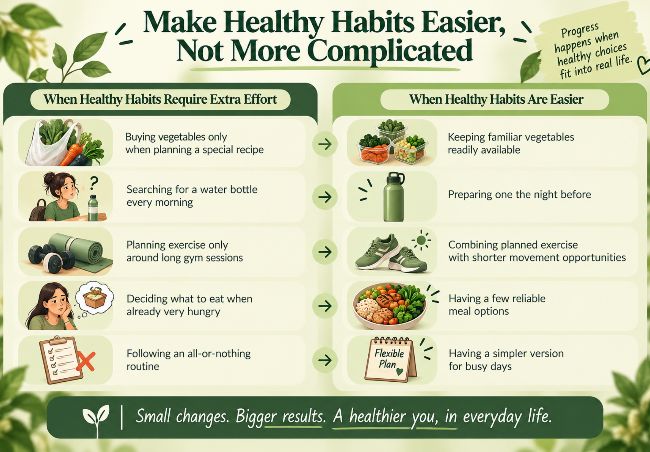
This principle can be applied to healthy lifestyle habits. Keeping a water bottle nearby may make drinking water more convenient. Having vegetables available at home can reduce the effort required to prepare a balanced meal. Placing comfortable walking shoes somewhere visible may serve as a reminder to move when an opportunity appears.
The opposite is also worth considering. If every healthy action requires extensive preparation, additional shopping, or a complicated decision, the routine may become difficult to sustain. A plan that works only when we feel energetic and highly motivated is unlikely to be reliable during demanding periods.
Instead of asking how to become more disciplined, consider how to reduce unnecessary effort. Sometimes the most effective improvement is not adding another wellness activity, but making an existing healthy option simpler, more accessible, and easier to repeat.
7. The Most Sustainable Routine Has Room for Imperfect Days
Even a thoughtfully designed wellness routine will sometimes be interrupted. A family member may become unwell, work may demand extra attention, or an unexpected commitment may change the entire day. These disruptions are normal parts of life rather than evidence that a routine has failed.
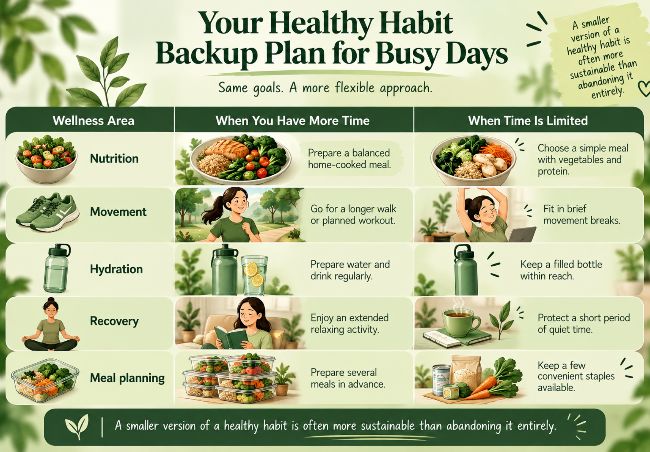
One way to manage them is to develop different versions of the same habit. On a day with more flexibility, you might prepare a balanced home-cooked dinner. On a demanding day, you might choose a simple takeaway meal with vegetables and a protein source. Both decisions can reflect an intention to care for your health, even though the amount of effort differs.
The same principle applies to movement and recovery. A longer walk may be possible on the weekend, while a weekday might allow only shorter periods of activity. Some evenings offer time for relaxation, while others require attention to urgent responsibilities. Flexibility allows habits to continue in a form that suits the circumstances.
It is also helpful to avoid interpreting one missed activity as a reason to abandon the entire routine. Skipping a walk does not erase previous movement. Eating a less balanced meal does not make the rest of the week’s choices meaningless. A sustainable approach allows us to return to our usual habits without treating every interruption as a fresh beginning.
Ultimately, everyday wellness is not about proving that we can maintain an ideal schedule under all conditions. It is about creating patterns that can adapt as life changes. When a routine includes room for busy days, unexpected events, and occasional imperfections, it becomes something we can live with rather than another standard we struggle to meet.
Conclusion
It is easy to imagine that healthier living will become possible once we have more free time. We picture calmer mornings, shorter workdays, and weekends without responsibilities. But for many people, that ideal schedule may never arrive, at least not in the way they expect.
The encouraging reality is that healthy lifestyle habits do not always require major changes to our daily routines. Balanced meals can be assembled from familiar foods, movement can be incorporated into ordinary activities, and small opportunities for recovery can be protected throughout the day. What matters is finding approaches that are realistic enough to maintain.
This does not mean that every person has equal time, resources, or control over their circumstances. Work demands, caregiving responsibilities, financial pressures, and health conditions can all influence what is possible. Recognising these differences helps us approach wellness with greater practicality and less judgment.
Rather than waiting for life to become less demanding, we can begin by looking at the routines we already have. One manageable improvement may lead to another, and over time, those choices can form a more consistent foundation for wellbeing. Your health deserves attention within your real life, not only in the version of life where you finally have nothing else to do.
Supporting Everyday Nutritional Wellness
Maintaining balanced nutrition is one part of building healthy habits that fit a busy lifestyle. For those looking for a convenient way to complement their daily nutritional routine, Chlorella Gold by Abeille d’Or contains chlorella, CGF, iron, and B vitamins and can be incorporated alongside varied meals, regular movement, and adequate rest.