



Your Brain Is Ageing Too: When Should You Start Taking Care of It?
Table of Contents
Introduction
1. Brain Health Is Not Only an Older Person’s Conversation
2. Different Stages of Life Put Different Demands on the Brain
3. Sleep Is One of the Foundations We Often Neglect
4. Your Body and Brain Are Not Separate Wellness Projects
5. Your Brain Still Needs New Experiences
6. Social Connection Is Part of Healthy Ageing
7. Think in Decades, Not Quick Fixes
Conclusion
Introduction
When people think about healthy ageing, they often think about the body first. We think about keeping our heart healthy, maintaining strong bones, protecting our joints, staying physically active, and keeping up with regular health screenings. These are important priorities, but there is another part of us ageing alongside the rest of the body: the brain.
Brain health can feel like something to worry about much later in life. When we are younger, our attention is usually elsewhere. We are studying, building careers, raising families, managing finances, caring for parents, and trying to keep up with increasingly busy lives. Unless something feels noticeably different, there may seem to be little reason to think about cognitive wellness.
But looking after the brain does not have to begin when we become older. Many of the everyday behaviours associated with general wellbeing, including physical activity, adequate sleep, balanced nutrition, learning, social connection, and managing stress, are relevant throughout adulthood. Rather than treating brain health as an issue belonging only to our future selves, we can make it part of how we think about health today.
For Malaysians, this conversation may feel particularly relevant as families increasingly include several generations living, working, and ageing alongside one another. We may find ourselves thinking about our parents’ wellbeing while also wondering what our own health could look like decades from now. That raises a useful question: when is the right time to start taking care of your brain?
1. Brain Health Is Not Only an Older Person’s Conversation
We tend to associate conversations about the ageing brain with later life. That is understandable. Changes in memory and cognitive function become more visible concerns as people grow older, so much of the public conversation naturally focuses on seniors.
But brain health is broader than memory in old age. Your brain is involved in learning, attention, decision-making, emotions, problem-solving, communication, coordination, and countless other processes you rely on throughout the day. Cognitive wellness therefore matters whether you are 25, 45, or 65.
Thinking about brain health earlier also changes the tone of the conversation. Instead of approaching it only from fear of what might happen later, we can think about supporting the brain we use every day. That means considering whether our lifestyles provide enough sleep, movement, nutritious food, mental stimulation, and genuine opportunities to recover.
There is no need to become anxious about every forgotten name or moment of distraction. Everyday forgetfulness can happen for many reasons, including being tired, stressed, distracted, or simply having too much on our minds. The more useful goal is to recognise the brain as something worth caring for throughout life, just as we do with other aspects of our health.
2. Different Stages of Life Put Different Demands on the Brain
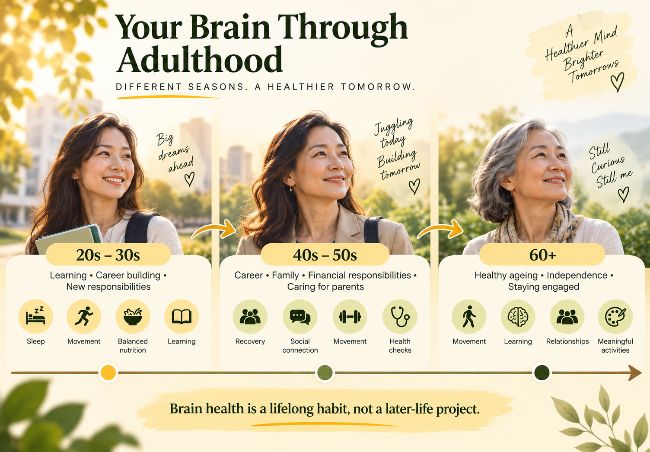
Our relationship with our brain changes throughout adulthood. In our twenties and thirties, cognitive demands may come from education, career development, relationships, financial decisions, and learning how to manage adult responsibilities. It can be an exciting period, but also a mentally demanding one.
By the thirties, forties, and fifties, the number of responsibilities can multiply. Work may become more demanding while family commitments grow. Some adults are raising children while simultaneously beginning to support ageing parents. The brain is constantly switching between professional decisions, household responsibilities, schedules, messages, finances, and relationships.
Later in life, priorities may shift again. Maintaining independence, staying socially engaged, continuing to learn, keeping physically active, and participating meaningfully in family and community life can become increasingly important.
There is therefore no single age when brain health suddenly becomes relevant. The needs may change, but caring for cognitive wellbeing can have a place at every stage of adulthood.
3. Sleep Is One of the Foundations We Often Neglect
Sleep is sometimes treated as the first thing we can sacrifice when life becomes busy. There is always another email to answer, another episode to watch, another task to complete, or another few minutes to spend scrolling on the phone before bed.
The problem is that the next morning still arrives at the same time. When shortened nights become a pattern, many people recognise the familiar consequences: difficulty concentrating, slower thinking, irritability, reduced patience, and the feeling that even simple decisions require more effort.
Good sleep habits do not require an elaborate nighttime routine. Consistent sleeping and waking times where possible, reducing unnecessary stimulation late at night, creating a comfortable sleep environment, and allowing enough time for rest are practical places to begin.
Instead of viewing sleep as time taken away from productivity, it can be more useful to see it as part of the foundation that allows us to function well. Caring for the brain sometimes begins with something remarkably ordinary: giving it enough opportunity to rest.
4. Your Body and Brain Are Not Separate Wellness Projects
It is tempting to divide health into separate categories. We have heart health, bone health, digestive health, mental wellbeing, and brain health. In everyday life, however, these systems exist within the same person.
Physical movement is a good example. We usually associate exercise with muscles, fitness, weight management, or cardiovascular health. But being physically active is also relevant to overall brain health. This means a walk around the neighbourhood, a badminton game, swimming, cycling, or another form of regular movement can contribute to a broader healthy lifestyle.
Nutrition works in a similar way. The brain requires energy and nutrients just like the rest of the body. Rather than searching for one magical “brain food”, a more sensible foundation is an overall balanced eating pattern that includes a variety of nutritious foods.
The useful lesson is that caring for your brain does not necessarily require building an entirely new wellness routine. Many of the habits you adopt for general health can also sit within a brain-conscious lifestyle. Looking after the body and looking after the brain are often part of the same conversation.
5. Your Brain Still Needs New Experiences
As children, learning is built into everyday life. Almost everything is new. We learn languages, numbers, social skills, sports, hobbies, and how the world works. By adulthood, life can become more repetitive.
Routine has advantages, but the brain still benefits from being engaged. Learning does not have to mean returning to university or completing difficult intellectual exercises. It can simply mean continuing to challenge yourself with unfamiliar experiences and skills.
Learning a language, trying a new recipe, playing a musical instrument, reading about an unfamiliar subject, learning new technology, travelling somewhere different, doing puzzles, or taking up a hobby can all provide opportunities to remain mentally engaged. Even learning something from a younger family member can turn an ordinary afternoon into a new experience.
The important point is curiosity. Cognitive wellness is not just about trying to preserve what we already know. It can also be about continuing to participate, explore, adapt, and learn as we move through different stages of life.
6. Social Connection Is Part of Healthy Ageing
Some of the most meaningful forms of mental stimulation do not feel like “brain exercises” at all. They happen around the dinner table, during a conversation with a friend, while playing with grandchildren, or when participating in a community activity.
Human interaction asks a great deal from the brain. We listen, interpret, remember, respond, laugh, tell stories, recognise emotions, and exchange ideas. At the same time, meaningful relationships contribute to emotional wellbeing and can make everyday life feel richer.
Malaysia’s family and community culture can make this particularly relevant. Multi-generational gatherings, meals with friends, neighbourhood activities, religious and cultural communities, and celebrations all create opportunities for people of different ages to remain connected.
As life becomes increasingly digital, however, being constantly connected to devices does not necessarily mean we feel socially connected. Making time for genuine conversation and shared experiences can be another simple way to think about wellbeing as we age.
7. Think in Decades, Not Quick Fixes
Modern wellness culture often promises fast results. A new routine will transform your productivity in seven days. A particular food will sharpen your mind. A morning ritual will change everything. Brain health is better approached with a much longer perspective.
Imagine thinking about your wellbeing not just for next week, but for the next ten, twenty, or thirty years. Suddenly, consistency becomes more important than intensity. A walk you can maintain matters more than an exercise plan you abandon after two weeks. A realistic bedtime routine matters more than occasionally trying to “catch up” on sleep.
The same applies to nutrition, learning, relationships, and mental recovery. None needs to be perfect. What matters is creating patterns that have a reasonable chance of surviving different seasons of life.
This perspective can also make healthy ageing feel less intimidating. You do not have to solve your future today. You simply need to begin treating your future wellbeing as something worth considering in the choices you make now.
Perhaps that is the answer to when we should start taking care of our brains. Not at 50. Not at 60. Not when we first become worried about ageing. The best time is while brain health still feels like something for the future.
Conclusion
We spend a great deal of time preparing for the future. We save money, develop our careers, plan for our families, and think about where we would like to be years from now. Caring for our brain deserves a place in that long-term thinking too.
Brain health does not suddenly become important when we reach a particular birthday. It accompanies us through every stage of adulthood, from learning and building a career to raising families, supporting ageing parents, and eventually navigating our own later years.
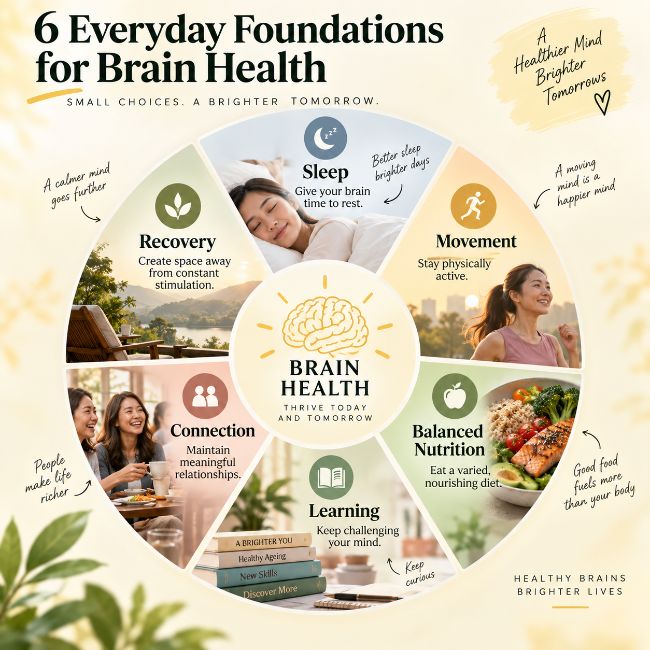
The encouraging part is that supporting cognitive wellness does not necessarily require a complicated new lifestyle. Sleep, physical activity, balanced nutrition, continued learning, meaningful relationships, and opportunities for recovery are all familiar habits. The challenge is simply to give them the importance they deserve.
Healthy ageing is not about trying to remain young forever. It is about giving ourselves the best possible foundation to remain engaged with our families, communities, interests, and everyday lives as the years pass.
Supporting Your Everyday Brain Wellness Routine
For those looking to complement a balanced lifestyle with nutritional support, IQ No.1 by Abeille d’Or combines bee pollen, royal jelly calcium, vitamin B complex, beta carotene, and rooibos tea extract in a formulation designed to support brain function, mental focus, and mood balance.