



What Does a Healthier Malaysia Look Like?
Table of Contents
Introduction
1. A Healthy Nation Begins With Everyday Life
2. Prevention Starts Before Something Feels Wrong
3. Our Food Culture Can Be Part of the Solution
4. Movement Does Not Have to Mean Going to the Gym
5. Healthy Families Can Influence Generations
6. A Healthier Malaysia Includes the Mind Too
7. National Change Can Begin With Personal Choices
Conclusion
Introduction
Every September, Malaysia Day gives us an opportunity to reflect on the country we have built together and the Malaysia we hope to create for future generations. We often think about progress through economic growth, education, infrastructure, technology, and opportunity. But there is another form of progress that affects almost every family in the country: the health and wellbeing of the people who call Malaysia home.
A healthier Malaysia is not simply one with more hospitals, clinics, or medical technology. Healthcare will always be essential, but the story of health begins much earlier. It begins at the breakfast table, during the commute to work, in the choices we make at lunch, in whether we find time to move our bodies, and in the routines we repeat before going to sleep. Many of the foundations of wellbeing are built quietly in everyday life.
This matters because preventive health is not only something for people who are older or already concerned about their health. It is a way of thinking about the future. Instead of waiting until wellbeing becomes a problem, preventive living asks a different question: what can we do today to give ourselves a stronger foundation for tomorrow?
As Malaysians celebrate the country we share, perhaps Malaysia Day can also inspire a broader conversation about what it means to build a healthier nation. A healthier Malaysia begins with healthier communities, healthier families, and ultimately, millions of small choices made by ordinary people every day.
1. A Healthy Nation Begins With Everyday Life
When we talk about the health of a country, it is easy to think primarily about the healthcare system. We think about doctors, hospitals, medicine, screenings, and access to treatment. These are important parts of national wellbeing, but they represent only one side of the picture.
Much of health happens outside a clinic. It happens in homes, offices, schools, neighbourhoods, restaurants, parks, and supermarkets. The meals people eat, the amount of movement they get, how well they sleep, and how they manage everyday stress all contribute to the bigger picture of wellbeing.
This means building a healthier Malaysia is not something that belongs exclusively to healthcare professionals or policymakers. Individuals and families have a role too. Small healthy lifestyle habits repeated across millions of households can collectively contribute to a culture where looking after health becomes part of normal everyday life.
That does not mean everyone needs to live perfectly. Malaysia is diverse, and our routines, responsibilities, budgets, and lifestyles are different. A healthier nation is not created by expecting everyone to follow the same ideal routine. It is created when healthier choices become more understandable, practical, and achievable for more people.
2. Prevention Starts Before Something Feels Wrong
For many of us, health becomes a priority when the body gives us a reason to pay attention. We feel unusually tired, receive an unexpected health screening result, or watch someone close to us experience a health challenge. Suddenly, habits that once seemed unimportant begin to feel much more significant.
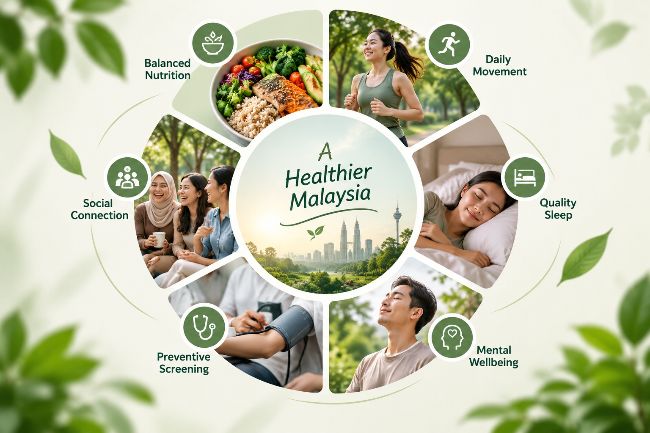
Preventive health encourages us to reverse that pattern. Instead of thinking about wellbeing only when something feels wrong, it asks us to care for ourselves while we are feeling well. Regular health screenings and professional medical advice are part of this picture, but so are everyday behaviours that support general wellbeing.
A balanced diet, regular physical activity, adequate sleep, hydration, stress management, and avoiding harmful habits may not feel dramatic. In fact, that is precisely why they are easy to underestimate. Their value comes from repetition over time rather than an immediate transformation.
Prevention is therefore less about fear and more about preparation. We cannot control every aspect of our future health, but we can build a stronger foundation through the choices available to us today.
3. Our Food Culture Can Be Part of the Solution
Food is deeply connected to Malaysian identity. From family gatherings and festive celebrations to kopitiam breakfasts and meals at the mamak, eating is one of the ways Malaysians connect with one another. Any conversation about becoming healthier has to recognise that food is more than nutrition. It is also culture, memory, community, and enjoyment.
That is why healthier eating should not mean rejecting Malaysian food or attempting to follow an unrealistic diet. A more sustainable approach is to think about balance. Portion sizes, cooking methods, the frequency of certain foods, the amount of vegetables on the plate, and what we choose to drink can all make a difference without removing the foods we love.
Adding rather than constantly restricting can also make healthy eating feel more positive. We can add more vegetables to meals, choose fruit more regularly, drink more water, or include a wider variety of whole foods. These are relatively simple changes that can gradually become part of normal eating habits.
A healthier Malaysia does not need to abandon its food culture. It needs a food culture where enjoyment and wellbeing can exist together. Healthy eating becomes much more sustainable when it works within people’s real lives rather than asking them to leave those lives behind.
4. Movement Does Not Have to Mean Going to the Gym
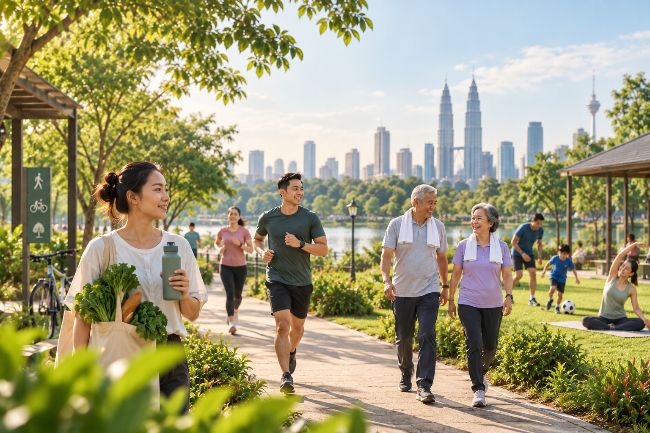
Exercise is another area where healthy living can become unnecessarily intimidating. When people hear that they should become more active, they may immediately imagine gym memberships, intense workouts, or complicated fitness programmes. For someone with a demanding job, family responsibilities, or a long commute, that can feel unrealistic.
Movement, however, can take many forms. Walking around the neighbourhood, taking the stairs, gardening, cycling, playing badminton, doing household activities, or spending an active afternoon with the family can all help make movement a more regular part of life.
The important shift is to stop thinking about physical activity as something that only “fitness people” do. Movement is a basic part of everyday wellbeing, and it can be adapted to different ages, abilities, and lifestyles.
A healthier society is one where being active feels accessible. Parks, walkable neighbourhoods, community activities, sports facilities, and supportive family routines can all help make movement a normal part of Malaysian life rather than another task people struggle to fit into an already busy schedule.
5. Healthy Families Can Influence Generations
Many of our earliest habits are learned at home. Children observe what adults eat, how they spend their free time, whether physical activity is normal, and how health is discussed within the family. Those experiences can influence their relationship with wellbeing for years to come.
This makes family habits particularly powerful. A child who grows up seeing vegetables regularly served at meals may develop a different relationship with them than someone who views vegetables as something they are forced to eat occasionally. Similarly, families that walk, play sports, or spend active time together can make movement feel like a normal part of life.
The influence also works in the other direction. Younger family members can encourage parents and grandparents to become more active, try healthier meals, attend health screenings, or learn more about nutrition. Healthy living does not always have to flow from one generation to the next. Families can motivate one another.
Malaysia’s strong family culture gives us an important advantage. When wellbeing becomes something families practise together rather than an individual responsibility carried alone, healthier habits have the potential to spread across generations.
6. A Healthier Malaysia Includes the Mind Too
Physical health is only one part of wellbeing. A truly healthier Malaysia also needs to recognise the importance of mental and emotional wellness. Busy working lives, financial responsibilities, caregiving, academic pressures, constant connectivity, and everyday stress can all place demands on our mental wellbeing.
Rest deserves a place in the health conversation. So do sleep, social connection, time away from screens, hobbies, and opportunities to slow down. These things may appear less measurable than exercise or nutrition, but they contribute to a lifestyle that feels more balanced and sustainable.
It is also important to move away from the idea that constantly being busy is a sign of success. Productivity matters, but so does recovery. People need time to recharge, connect with others, and enjoy life outside their responsibilities.
When we broaden our understanding of health to include both body and mind, preventive health becomes more complete. We stop viewing wellbeing simply as the absence of illness and begin thinking about the quality of our everyday lives.
7. National Change Can Begin With Personal Choices
The idea of creating a healthier country can feel enormous. After all, no individual can change the health of an entire population. But national habits are ultimately made up of individual habits repeated across homes and communities.
One person choosing water more often may seem insignificant. One family adding more vegetables to dinner may not appear to change anything beyond their household. One person deciding to walk regularly, protect their sleep, or attend an appropriate health screening may feel like a purely personal decision. Multiply these behaviours across communities, however, and the picture begins to change.
This is where personal responsibility and supportive environments meet. Individuals can make healthier choices, while families, workplaces, communities, businesses, and public institutions can help make those choices easier. Sustainable change rarely comes from telling people simply to try harder. It comes from creating a culture where wellbeing is valued and supported.
Malaysia Day celebrates what can be achieved when people with different backgrounds share a common future. Perhaps health deserves a place within that future too. Not as a temporary campaign or another resolution, but as an ongoing commitment to helping more Malaysians live well for longer.
Conclusion
So, what does a healthier Malaysia actually look like? It does not look like a country where everyone follows the same diet, exercises the same way, or maintains a perfect wellness routine. It looks like a country where more people have the knowledge, opportunity, and encouragement to make choices that support their wellbeing.
It looks like families eating more balanced meals without losing the food traditions they love. It looks like movement becoming part of everyday life, preventive health receiving attention before problems arise, and mental wellbeing being treated as an important part of overall health. Most importantly, it looks like healthy living becoming something practical rather than something reserved for people with unlimited time or resources.
Malaysia’s future will be shaped by many things, and the wellbeing of its people is one of them. This Malaysia Day, alongside celebrating the nation we have built together, we can also think about the Malaysia we want to grow older in and the everyday choices that can help us move towards it.
Supporting Everyday Wellness
For those looking to complement balanced nutrition and healthy lifestyle habits with everyday nutritional support, Chlorella Gold by Abeille d’Or contains chlorella, CGF, iron, and B vitamins and can be incorporated into a balanced daily wellness routine.