



Is Malaysian Food Really Unhealthy?
Table of Contents
Introduction
1. There Is No Single “Malaysian Diet”
2. One Meal Does Not Define Your Diet
3. Sometimes the Plate Matters More Than the Dish
4. Don’t Forget What You’re Drinking
5. Vegetables Can Be the Missing Piece
6. Healthy Eating Has to Survive Real Malaysian Life
7. We Don’t Need to Choose Between Culture and Health
Conclusion
Introduction
Ask Malaysians what they love about Malaysia and food will almost certainly enter the conversation. Nasi lemak in the morning, chap fan at lunch, banana leaf rice with friends, a bowl of noodles on a rainy afternoon, or a late-night visit to the mamak are more than meals. Food is woven into how Malaysians socialise, celebrate, travel, and connect across cultures.
At the same time, Malaysian food sometimes receives a less flattering label: unhealthy. Rice has too many carbohydrates. Nasi lemak is too rich. Roti canai is too oily. Hawker food is too salty. Kopi is too sweet. Once enough foods are placed on the “bad” list, eating healthily can begin to sound as though it requires giving up everything familiar and replacing it with salads, grilled chicken, and foods that barely resemble what we normally eat.
But nutrition is rarely that simple. Foods are not eaten in isolation, and health is not determined by one plate of char kway teow or one weekend teh tarik. What matters more is the overall pattern: how often we eat certain foods, how much we eat, what else appears on the plate, what we drink, and how our choices fit into the rest of our lifestyle.
So perhaps the better question is not whether Malaysian food is unhealthy. Perhaps it is: how can we continue enjoying Malaysian food while building a more balanced way of eating? The answer may require far less sacrifice than many people assume.
1. There Is No Single “Malaysian Diet”
Calling Malaysian food unhealthy creates an immediate problem because there is no single Malaysian cuisine. Our food culture is a remarkable mixture of Malay, Chinese, Indian, Peranakan, indigenous, regional, and international influences. Even dishes with the same name can be prepared differently depending on the household, state, or restaurant.
Consider something as simple as rice. It might be served with grilled fish and ulam, vegetables and tofu, curry and dhal, steamed chicken, or several fried dishes. The rice itself tells us very little about the nutritional quality of the entire meal.
The same applies to eating out. A visit to a kopitiam, food court, hawker centre, or mamak can result in very different meals depending on what we order. Malaysian food culture gives us plenty of indulgent options, but it also gives us vegetables, soups, legumes, tofu, eggs, fish, fruit, herbs, and many other foods that can form part of balanced eating.
Instead of labelling an entire cuisine as healthy or unhealthy, it is more useful to look at the composition and frequency of our everyday choices. That gives us much more room to improve our diets without rejecting our culture.
2. One Meal Does Not Define Your Diet
Nutrition conversations often focus heavily on individual foods. We ask whether nasi lemak is healthy, whether we should stop eating rice, or whether having roti canai for breakfast is “bad”. But this way of thinking can make food unnecessarily stressful.
Imagine someone who enjoys nasi lemak once a week but generally eats a varied diet with vegetables, fruit, protein-rich foods, and appropriate portions. Compare that with someone who avoids nasi lemak completely but regularly consumes very few vegetables and drinks several sweetened beverages each day. Looking at one dish alone would tell us very little about either person’s overall eating pattern.
This is why balance matters. An occasional richer meal can comfortably exist within an otherwise nutritious routine. What becomes more important is what happens repeatedly over days, weeks, and months.
Thinking in patterns also removes some of the guilt surrounding food. Healthy eating should not require us to categorise every meal as a success or failure. A more sustainable goal is to make nourishing choices regularly while leaving room to enjoy the foods that make Malaysian eating culture so special.
3. Sometimes the Plate Matters More Than the Dish
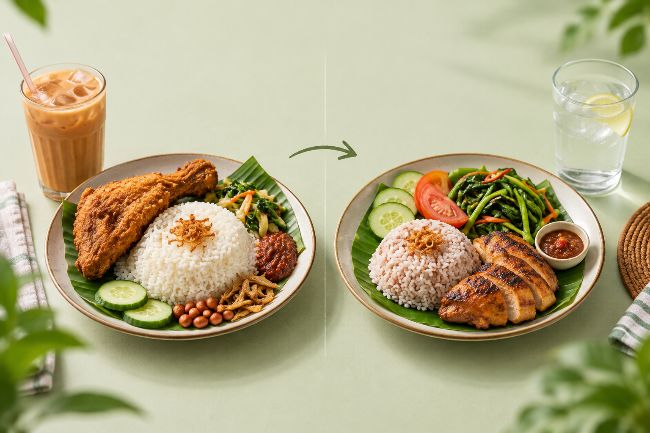
Rather than immediately removing favourite foods, one of the simplest ways to improve a meal is to look at the entire plate. Is most of it made up of rice or noodles? Is there a source of protein? Are vegetables noticeably present? What are you drinking alongside the meal?
Take mixed rice as an example. The experience can look very different depending on what goes onto the plate. A meal dominated by rice and several fried or rich dishes is different from one that includes a more moderate portion of rice alongside vegetables and a suitable protein choice.
The same principle can be applied at home. A familiar Malaysian meal does not suddenly need to become a completely different cuisine. Increasing the vegetable portion, adjusting the balance between dishes, choosing lighter cooking methods more frequently, or serving fruit afterwards can gradually change the overall nutritional picture.
This approach is much easier to sustain because it works with existing eating habits. Instead of asking, “What do I have to stop eating?” we begin asking, “What could I add or adjust to make this meal more balanced?”
4. Don’t Forget What You’re Drinking
When people try to improve their diets, they naturally focus on food. Drinks can receive much less attention even though they are part of our everyday eating habits.
Malaysia has a strong beverage culture. Teh tarik, kopi, Milo drinks, bubble tea, sirap, canned drinks, and other sweetened beverages are easy to find and often accompany meals or social occasions. They can also become habits without us noticing how frequently we consume them.
The goal does not have to be eliminating every favourite drink. A more practical approach is to consider frequency and sweetness. Ordering drinks less sweet, alternating sweetened beverages with plain water, or choosing unsweetened options more regularly can gradually shift the overall balance of the diet.
This is a good example of why healthy eating does not always require dramatic changes. Sometimes one of the simplest improvements happens not on the plate, but in the glass next to it.
5. Vegetables Can Be the Missing Piece
One of the easiest questions to ask when looking at a meal is simply: where are the vegetables? Not because vegetables magically make every meal healthy, but because they contribute fibre, vitamins, minerals, and variety to an overall balanced diet.
Malaysian cuisine certainly does not lack vegetables. Kangkung, sawi, kailan, cabbage, bean sprouts, okra, cucumber, long beans, leafy greens, and many others appear throughout our different cuisines. The challenge is often whether they occupy a meaningful place in our everyday meals.
When eating outside, vegetable portions can sometimes be relatively small compared with rice, noodles, meat, or fried foods. On busy days, they may disappear altogether because convenience tends to favour foods that are quick, filling, and easy to purchase.
A useful goal is therefore not to create the perfect meal every time, but to make vegetables more visible and more regular. Add an extra vegetable dish when sharing food. Choose another vegetable at mixed rice. Keep simple vegetables available at home. Small additions repeated frequently can make a meaningful difference to dietary variety.
6. Healthy Eating Has to Survive Real Malaysian Life
It is easy to design a healthy eating plan on paper. Real life is more complicated. There are early morning commutes, office lunches, family dinners, school runs, food delivery apps, mamak gatherings, festive seasons, birthday celebrations, and days when cooking simply is not going to happen.
Any approach to healthy Malaysian food needs to work within that reality. If a diet requires someone to prepare every meal from scratch, avoid eating socially, or reject most familiar foods, it may be difficult to maintain regardless of how nutritious it appears.
Flexibility is what makes balanced eating sustainable. Someone eating at a food court can still think about vegetables and portions. Someone having dinner at the mamak can still consider what they drink. Someone enjoying a celebration can eat differently from their usual routine without believing they have ruined their diet.
Healthier choices do not need to happen at every meal. They need to happen often enough to become the normal pattern. That is a much more realistic way to approach nutrition in a country where food is such an important part of everyday social life.

7. We Don’t Need to Choose Between Culture and Health
Food carries meaning. A dish prepared by a grandparent, a favourite breakfast from the neighbourhood kopitiam, or a meal shared during a festival cannot be reduced to a nutritional calculation. These experiences are part of wellbeing too.
The problem begins when healthy eating is presented as though cultural foods and good nutrition cannot coexist. That creates an unnecessary choice: either enjoy the foods you grew up with or become “healthy”. In reality, there is plenty of room between those extremes.
We can preserve traditions while adapting everyday habits. We can enjoy richer dishes occasionally while choosing simpler meals at other times. We can keep rice on the plate while making more room for vegetables. We can enjoy teh tarik with friends without needing every drink throughout the week to be sweetened.
Perhaps the future of healthy Malaysian eating is not about replacing our food culture at all. It is about becoming more intentional within it, keeping everything we love about Malaysian food while gradually building habits that support our wellbeing.

Conclusion
So, is Malaysian food really unhealthy? That question may be too simplistic. Malaysia has an extraordinarily diverse food culture, and no single dish, ingredient, or cuisine determines whether someone’s overall diet is balanced.
What matters more is the pattern we create around our favourite foods. Portions, vegetables, cooking methods, drinks, frequency, and variety can all influence that pattern. Improving these areas does not require us to stop enjoying nasi lemak, abandon the mamak, or turn every lunch into a salad.
Healthy eating becomes much more realistic when it works with our culture rather than against it. Instead of chasing a perfect diet, we can make small adjustments to the meals we already know and love. A little more balance, repeated consistently, can go much further than an extreme eating plan we cannot sustain.
Making Daily Greens More Convenient
For those looking for a simple way to complement their vegetable intake on busy days, Green Kale by Abeille d’Or provides the equivalent of four servings of kale per sachet and can be incorporated into a balanced daily eating routine.